
Some words give away their own origin, and the German word for drinking straw, „Strohhalm”, is one of them. No marketing in it, no invented term, just a description: a stalk of straw. That is exactly what it once was. How a dried cereal stalk became paper, then plastic, and today a plant-based product again is a surprisingly entertaining story about hospitality, inventiveness and a long road back to the beginning.
Gold, lapis lazuli and a cloudy beer
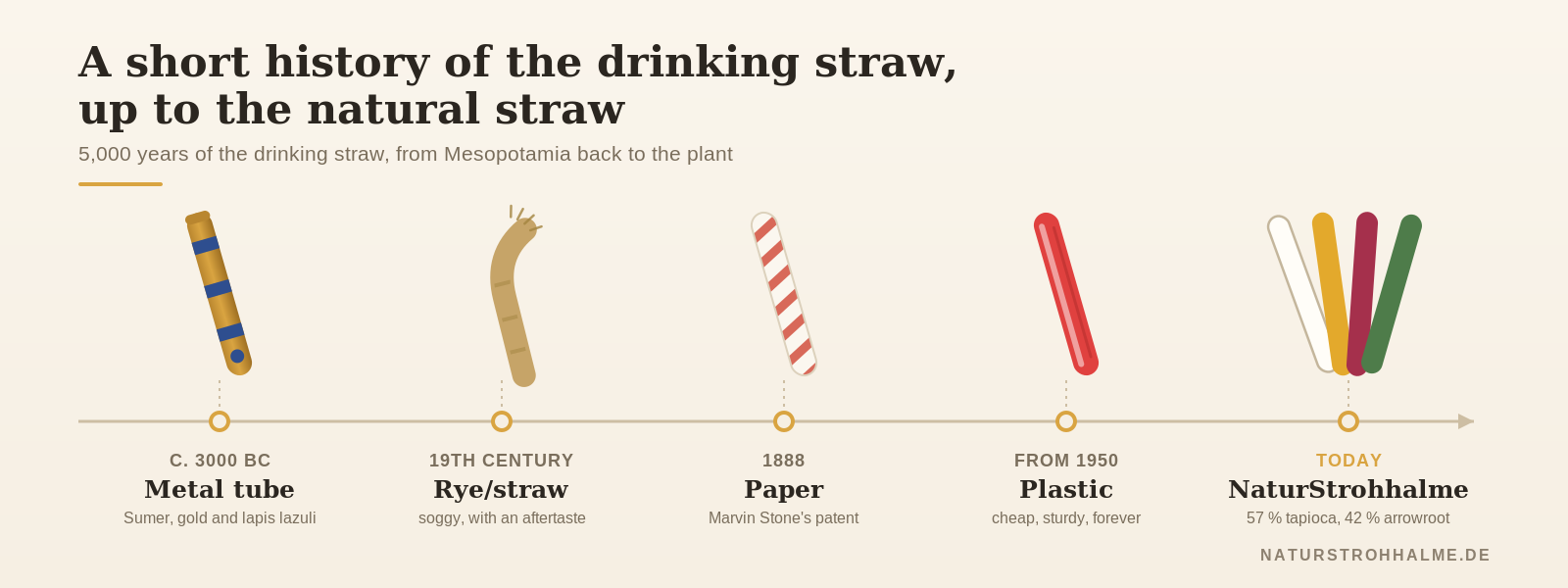
The oldest known drinking straw is around 5,000 years old and comes from Mesopotamia. Sumerian drinking vessels were large jars in which beer was fermented and consumed communally. Floating on top was a layer of malt residue and yeast. Anyone who wanted to reach the drink needed a tube that started below that layer.
What has survived are tubes made of precious metal, decorated with gold and lapis lazuli, found in royal graves. So the drinking straw was both things at once: a technical necessity and a status symbol. A theme that runs through its entire history.
You will find something similar in many cultures. In Vietnam, rice wine is still drunk from a shared clay jar through hollowed-out bamboo tubes that all guests use at the same time. Straws were never just an accessory, they shaped the way people drink together.
Why we still say „Strohhalm”
In the 19th century, people in Europe and North America reached for whatever was left in the fields: dried rye and wheat stalks. They were hollow, free and available everywhere. They were never good.
- They went soft within minutes and folded over in the glass
- They gave off a distinctly strawy aftertaste
- They frayed and left particles in the drink
- They were hard to control hygienically
For a Mint Julep, the fashionable drink in American bars at the time, this was a small disaster. The stalk fell apart faster than the ice melted.
1888: a pencil, a strip of paper, a patent
The American Marvin Stone had had enough. He worked in a factory producing paper cigarette holders and knew his way around wound paper. So he wrapped a narrow strip of paper in a spiral around a pencil, glued the seam and pulled the pencil out.
In 1888 he filed the result for a patent. Shortly afterwards his company in Washington began producing paper straws in series, initially for soda fountains and bars. Within a few years the factory was making more straws than cigarette holders. Hospitality had its first industrially manufactured single-use product for direct mouth contact.
The bend and the plastic age
The second big idea came in 1937 from Joseph Friedman. He watched his young daughter sitting at a counter, unable to reach her milkshake because the glass was too tall. Friedman pushed a screw into a paper straw, wound dental floss around it and formed a groove. The bendy straw was born, at first mainly for hospitals and patients lying down.
After the Second World War the material changed. Plastic was cheap, dimensionally stable, taste-neutral and available in any colour. The paper straw lost the race within a single generation.
The very advantage that made plastic win later became its problem: a material that still looks new in the glass after two hours also still looks that way in the environment after decades. In 2021, the EU Single-Use Plastics Directive ended an era that had barely lasted seventy years.
Back to the ingredients
And that closes the circle, although at a different level. What reaches the bar today is plant-based again, only without the weaknesses of the rye stalk of 1880.
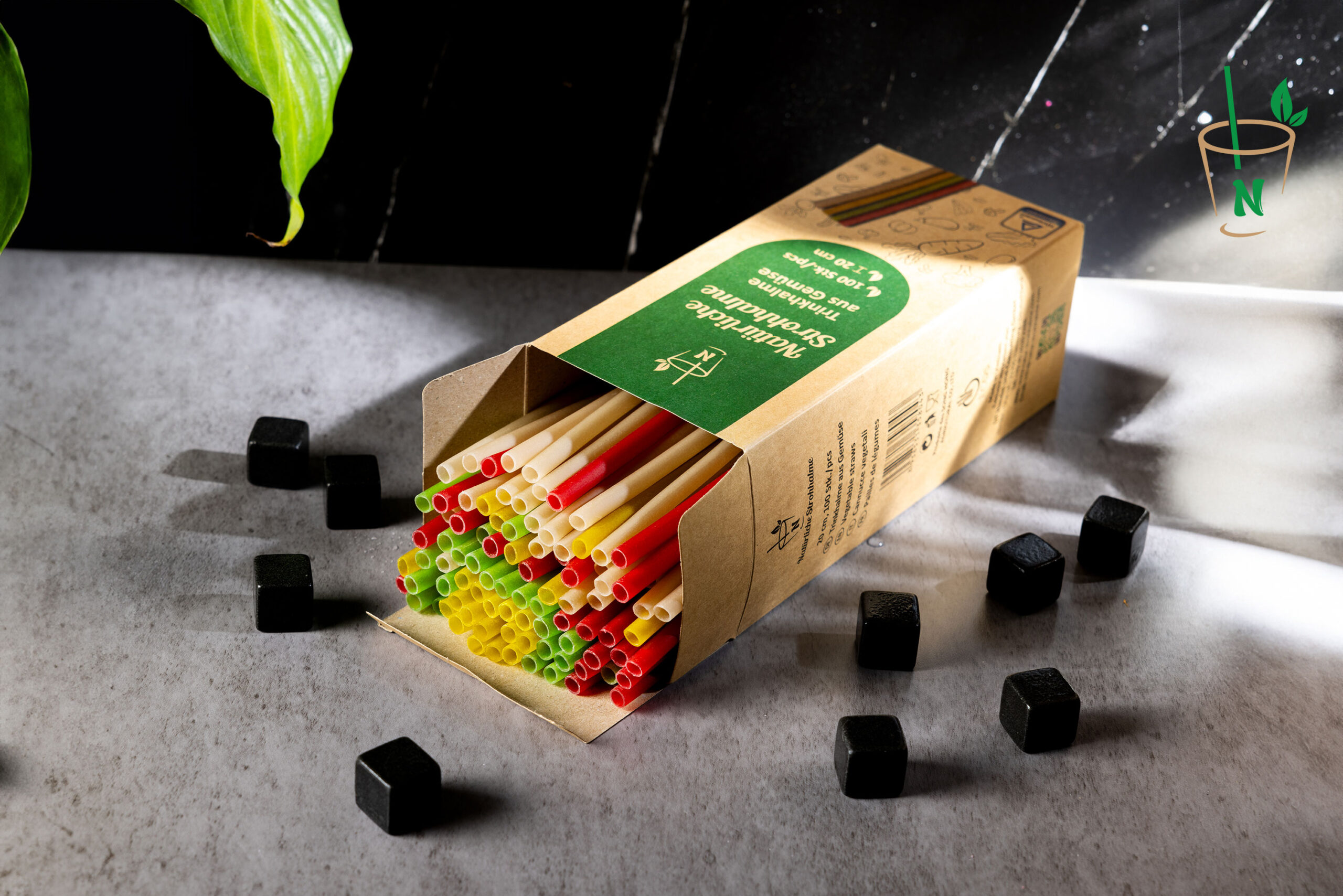
NaturStrohhalme are made from 57 % tapioca and 42 % arrowroot. They are taste-neutral, hold their shape for up to 2 hours in cold drinks and are produced entirely without any coating, which means no typical PFAS source arises here. After use there is no wash cycle and no sorting. Where the straw goes next is set by your waste contractor.
The colours come from real ingredients too:
- White (natural): clear, minimal, works with anything
- Yellow (turmeric): warm and lively, ideal for tropical drinks
- Red (beetroot): bold, for fruit-forward or dark cocktails
- Green (pandan): fresh, ideal for highballs and garden cocktails
A red straw in a Negroni or a green one in a Cucumber Gimlet does not read as a foreign object to anyone. The ancient Sumerians would probably have understood.
What matters in day-to-day operations
For bars and hotels, the hard facts are what count:
- ✅ tested against EU requirements for food contact
- ✅ vegan (V-Label) and gluten-free, therefore suitable for every guest
- ✅ no coating
- ✅ no cleaning, no return logistics, no dishwashing costs
Ø 8 × 20 cm is our most ordered format in hospitality. More than 95 % of our orders come from hospitality businesses that reorder roughly every 3 months. That says less about us than about daily life behind the bar: what works gets reordered.
Five thousand years later, the drinking straw is once again what it was at the start: a piece of plant that makes a drink better.
Ready to switch your business to straws made from real vegetables? Order our natural straws today and put something on the table your guests will remember.
St. Martin and the art of sharing: an old idea for a new kind of hospitality
In early November, darkness falls early. And then, on an evening around 11 November, they...
Read morePaper straws: less green than you think. What a study from South Korea shows
When the plastic straw disappeared from Europe’s bars in July 2021, the paper straw was...
Read moreMicroplastics in the glass: what research says about beverages
A guest orders a still water, you serve it in a clean glass, nothing looks...
Read moreGuests with allergies at the bar: what they ask before they order
A guest sits down at your bar, glances at the cocktail menu and asks before...
Read moreCreative Halloween Decor with NaturStrohhalme: Have You Thought of This Yet?
For many bars and restaurants, Halloween is the one time of year when decor matters...
Read moreFederweißer, pumpkin, apple: the autumn menu 2026
Evenings are getting cooler, guests are trading Aperol for something warmer, and suddenly your bar...
Read moreA short history of the drinking straw, up to the natural straw
Some words give away their own origin, and the German word for drinking straw, „Strohhalm”,...
Read more57 % tapioca, 42 % arrowroot: what’s actually inside the straw
There’s one question almost every buyer asks us before placing a first pallet order: “So...
Read more