
On 20 September, a lot of German towns hand the day over to children. Street festivals, special programmes in theme parks, ice cream parlours full all afternoon. For your business that means one thing above all: families are out, and the kids are ordering too. A child doesn’t decide the bill, but they very much decide where the family eats next time.
Family hospitality is a market of its own
World Children’s Day is a fixture in the German calendar, and in Thuringia it’s even a public holiday. Municipalities run children’s festivals, clubs organise activity days, theme parks put on special programmes. The afternoon belongs to families.
This is exactly the audience that gets skipped when equipment decisions are made. The bar debates cocktail presentation while the ice cream parlour next door serves a hundred children a day through a straw that goes soft after ten minutes. What matters for family businesses:
- The straw has to still work when the child spends twenty minutes talking instead of drinking
- Parents ask about material and ingredients, right there at the table
- Safety comes before looks, especially with the youngest guests
- Staff have no time to bring replacements to the same table twice
With children, material becomes a safety question
For adults it’s about feel and presentation. At the children’s table the criteria shift. What looks elegant next to a gin and tonic can be unsuitable for a four-year-old.
- Paper softens, and softened fibres can be swallowed. Add the adhesive holding the layers together and usually a coating to make it water-resistant at all. PFAS in paper straws has come up repeatedly in European studies in recent years.
- Plastic is off the table in EU hospitality anyway. Research into microplastics accumulating in the body and affecting the hormone system is ongoing.
- Glass can break: knocked against the rim, dropped, caught while clearing. Splinters in a child’s drink or ice cream sundae are hard to find again reliably at a busy family table.
- Metal reacts to acidity, which is exactly what’s in lemonade, orange juice and apple spritzer. Oxidation marks and a metallic aftertaste are possible.
- Rice straws take up liquid comparatively quickly, and the surface changes noticeably while they do.
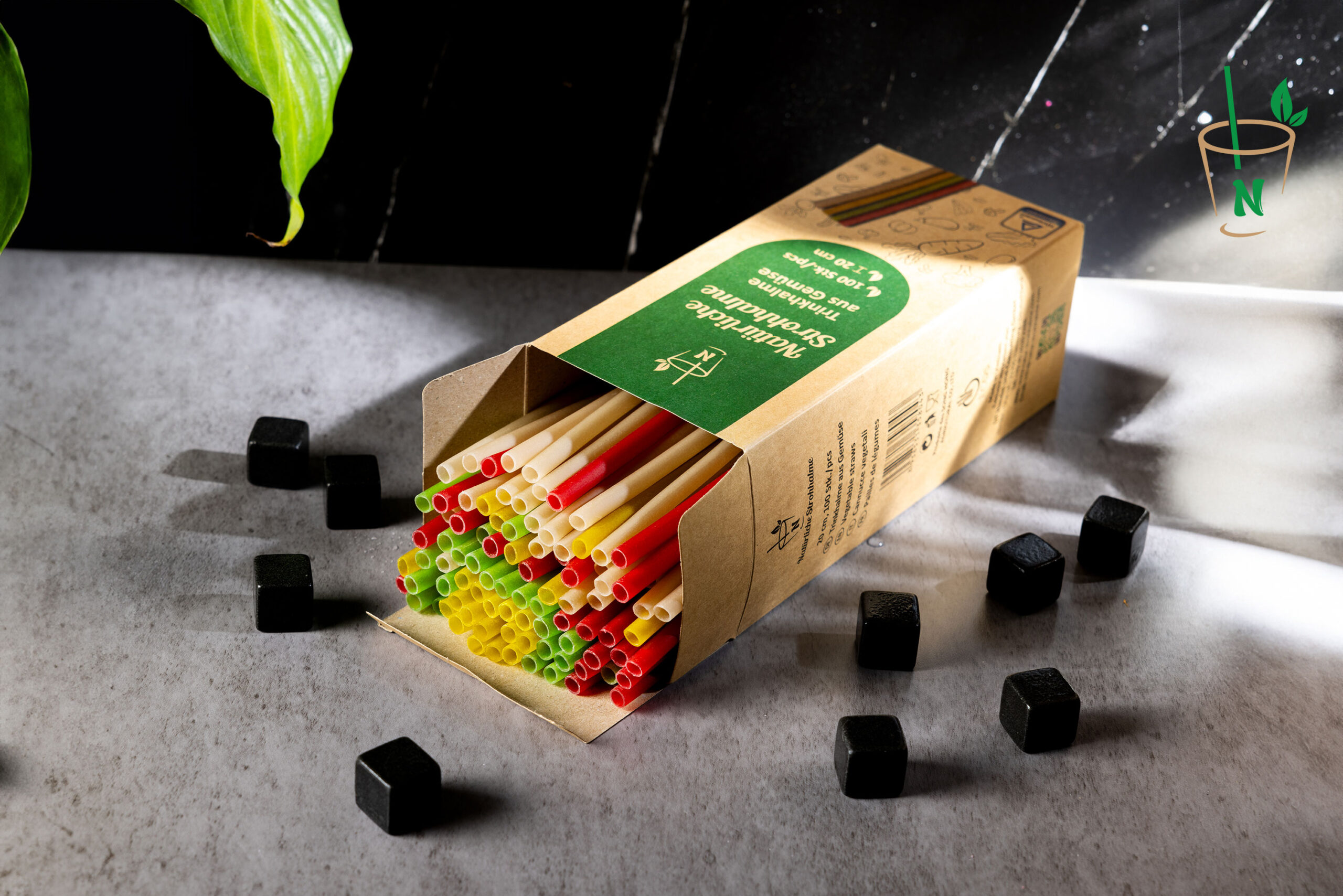
NaturStrohhalme are made from 57% tapioca starch and 42% arrowroot flour, with no artificial colourings and no coating, which also means no typical PFAS source. In cold drinks they hold their shape for up to two hours and stay taste-neutral. No breakage, no splinters, no metallic aftertaste.
Parents now ask about ingredients
The allergen question used to come up with the food. Now it comes up with the accessories too, particularly when there’s coeliac disease or an intolerance in the group. An answer you can give at the table:
- Gluten-free, which removes one of the most common follow-up questions
- Vegan certified (V-Label)
- Tested against EU food-contact requirements
- No coating, therefore no typical PFAS source
- No plastic content, the base is tapioca and arrowroot starch
The practical value isn’t the certificate itself. It’s that your service staff can give a short, safe answer without walking back to the kitchen.
Colours children recognise straight away
The four colours come from real ingredients, without artificial colourings:
- White (natural) clear and universal, works with anything
- Yellow (turmeric) warm and friendly, ideal for fruit juices and lemonades
- Red (beetroot) bold, for cherry spritzers or strawberry shakes
- Green (pandan leaf) fresh, good for iced tea and summer drinks
Colour lands more directly with children than with adults. A green straw in a green drink gets commented on, photographed, and sent to the family group chat by the parents. That’s free visibility for an item you’re buying anyway.
Which size suits which children’s drink
Ø 8 × 20 cm is our most-ordered format in hospitality. For ice cream parlours it’s worth pairing it with Ø 12, since shakes simply won’t come through otherwise and the straw turns into decoration.
What it leaves you with in daily operation
On a day like World Children’s Day, every movement you save counts. The straw is single-use: no cleaning, no returns, no sorting. Where it goes after the drink is set by your waste contractor.
Over 95% of our orders come from hospitality businesses that reorder roughly every three months. Once you’ve built up stock, you start planning in quarters rather than weeks. For seasonal peaks like September, a slightly larger order in advance pays off.
As an occasion, a small gesture is often enough: a straw colour-matched to the child’s drink, maybe a table card with one line about the material. Parents read things like that, and they remember the places that thought about the small details.
Ready to switch your business to straws made from real vegetables? Order our natural straws today and put something on the table your guests will remember.
St. Martin and the art of sharing: an old idea for a new kind of hospitality
In early November, darkness falls early. And then, on an evening around 11 November, they...
Read morePaper straws: less green than you think. What a study from South Korea shows
When the plastic straw disappeared from Europe’s bars in July 2021, the paper straw was...
Read moreMicroplastics in the glass: what research says about beverages
A guest orders a still water, you serve it in a clean glass, nothing looks...
Read moreGuests with allergies at the bar: what they ask before they order
A guest sits down at your bar, glances at the cocktail menu and asks before...
Read moreCreative Halloween Decor with NaturStrohhalme: Have You Thought of This Yet?
For many bars and restaurants, Halloween is the one time of year when decor matters...
Read moreFederweißer, pumpkin, apple: the autumn menu 2026
Evenings are getting cooler, guests are trading Aperol for something warmer, and suddenly your bar...
Read moreA short history of the drinking straw, up to the natural straw
Some words give away their own origin, and the German word for drinking straw, „Strohhalm”,...
Read more57 % tapioca, 42 % arrowroot: what’s actually inside the straw
There’s one question almost every buyer asks us before placing a first pallet order: “So...
Read more