
There’s one question almost every buyer asks us before placing a first pallet order: “So what is this thing actually made of?” A fair question. Anyone serving guests is accountable for what goes into the glass, and “something plant-based” isn’t an answer that satisfies a head chef or an auditor.
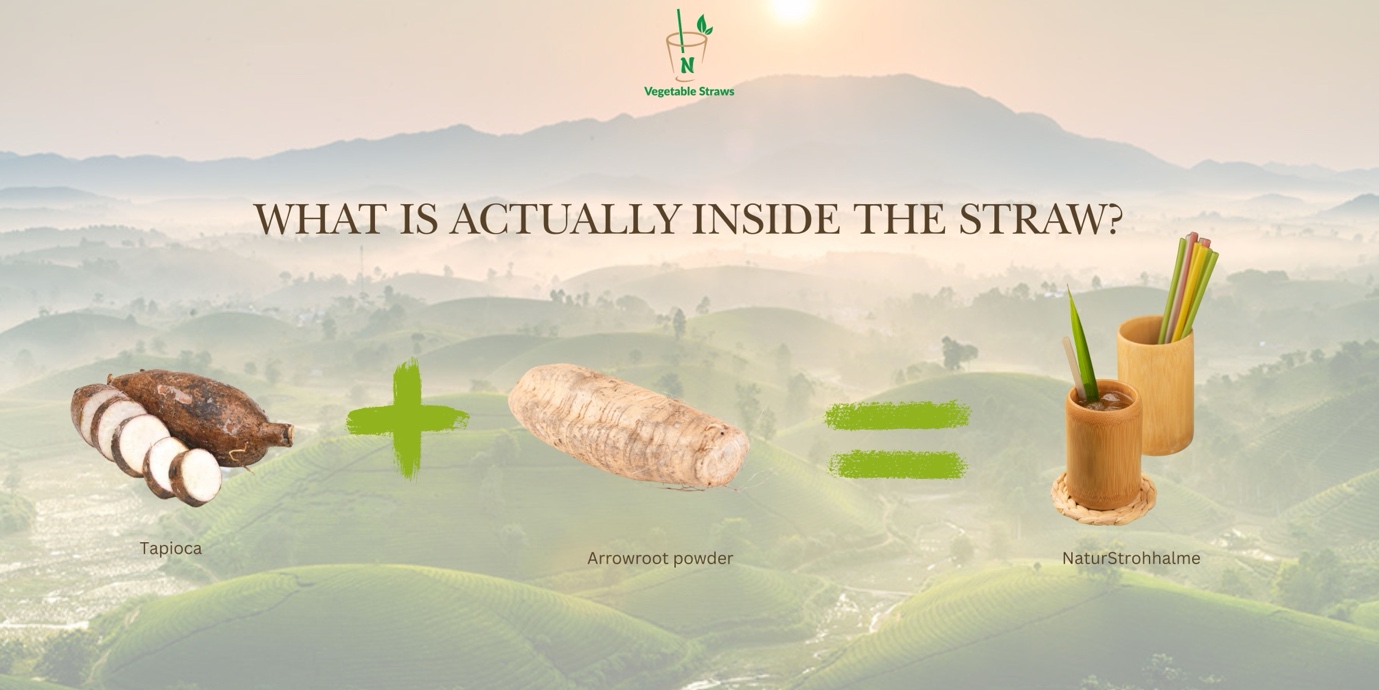
So here’s the full recipe, with no marketing fog: 57 % tapioca, 42 % arrowroot. Two roots, one straw. The final percent goes to colour, and that comes from the vegetable aisle too.
Tapioca: the starch from the cassava root
Tapioca is the starch extracted from the cassava root. You probably know the result from bubble tea, from Asian desserts, or as a binder in gluten-free baking. In our straw it acts as the frame: it’s what holds the structure together while your guest is drinking.
A few things that make the crop interesting:
- Cassava grows in tropical regions on soils too poor for many other crops.
- The plant handles dry spells and needs comparatively little irrigation.
- Only the root is harvested; the above-ground biomass stays on the field.
- The raw material is an established food, not a technical compound invented for packaging purposes.
That last point is where we differ from a lot of so-called bio-plastics. Our supply chain starts with a field and a foodstuff.
Arrowroot: the quiet partner at 42 %
Arrowroot is the lesser-known half of the mix, and the decisive one when it comes to holding up in a glass. The starch from the arrowroot tuber is unusually fine and gels cleanly. It’s the reason our straws keep their shape for up to 2 hours while staying taste-neutral.
Anyone who has fished a soggy paper straw out of an aperitif after ten minutes knows why we keep coming back to this. A straw that folds in the middle while the guest is still at the table won’t cost you a complaint, but it will cost you the impression.
Arrowroot also brings:
- a very mild character, which leaves a gin and tonic or a clear spirit untouched
- good tolerability, which is why the starch is traditionally used in baby food and bland diets
- gluten-free status, so it’s uncritical for guests with coeliac disease
The final percent: colour
That leaves the small remainder of the recipe. It goes to the colourants, and those come from ingredients you might find in any kitchen:
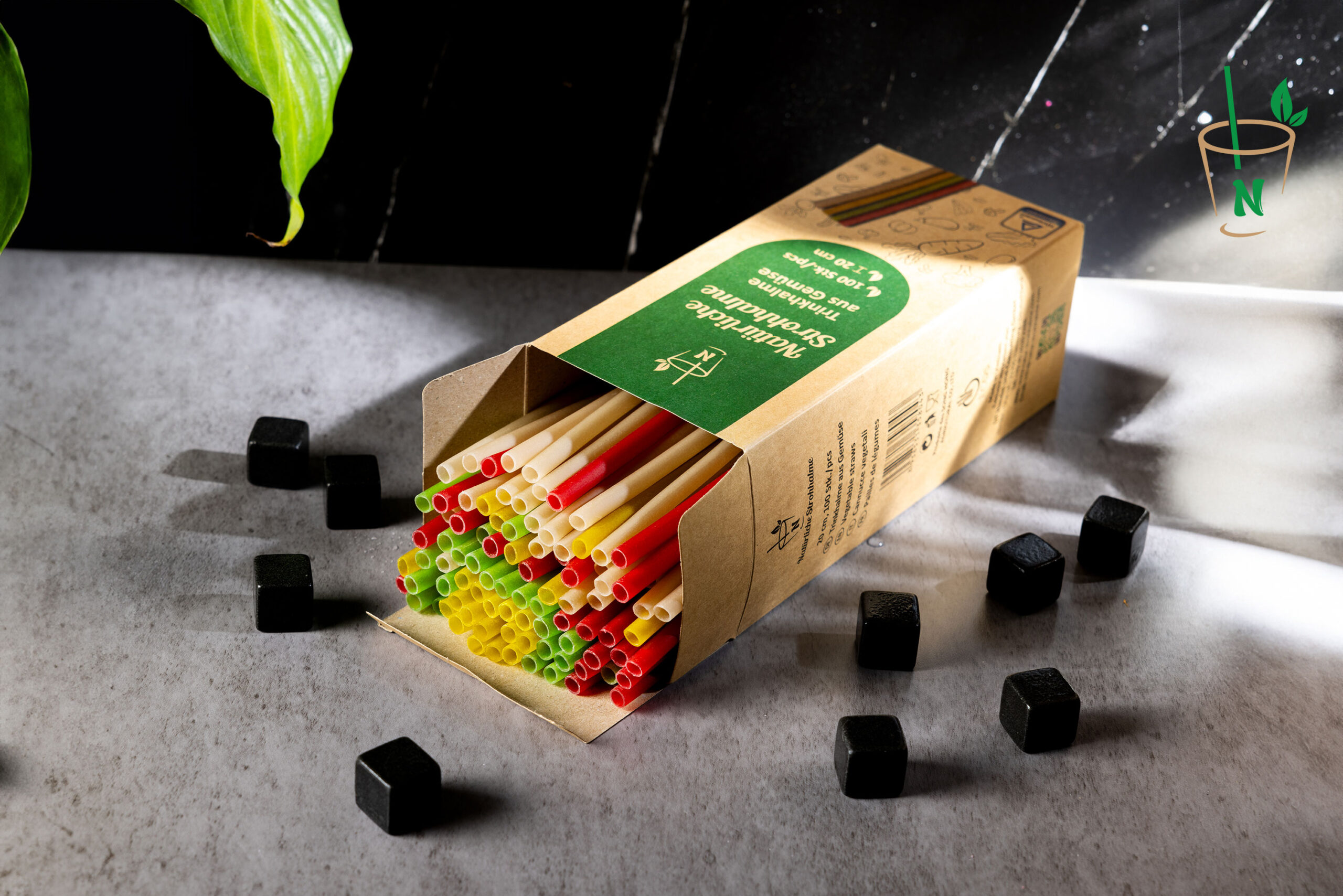
- White (natural): no colour added, the straw in its raw form
- Yellow: turmeric
- Red: beetroot
- Green: pandan leaves
One percent sounds like a footnote, but it decides whether a straw belongs to the drink or sits in it like a foreign object. A red straw in a fruit-forward sour, a green one in a cucumber gimlet: that’s staging, and it costs you nothing extra in the recipe.
What’s missing here matters just as much: no artificial colourants are used. For operations that publish a sustainability report, that’s one less sentence the comms team has to qualify.
What eventually happens to two roots
The straw isn’t a magic trick, it’s tapioca and arrowroot starch. Anything made of starch gets recognised by microorganisms for what it is: food. Starch comes from plants, which is why our straws carry no coating and no plastic content.
How fast that happens depends on temperature, moisture and soil life. We deliberately don’t put a figure on it while we have no test report to support one.
What we can back up is in the straw itself: two roots, no coating, no plastic.
Relevant for your disposal routine: the straw is a single-use product. Where it goes is set by your waste contractor, and in Germany the rules for organic waste tightened in May 2025. No cleaning, no sorting, no wash cycle, no discussion about breakage rates the way there is with glass or stainless steel.
What the recipe doesn’t contain
Sometimes the shorter list says more:
- no plastic and no plastic coating
- no coating at all, which removes the typical PFAS source found in coated single-use items
- no artificial colourants
- no animal-derived components; the product is vegan (V-Label)
- no gluten
And one point we find ourselves clarifying often: there is no rice in it. The confusion comes from several straw types on the market being made from cereal starch. Our base is roots.
What this means in practice for your operation
The recipe is one half of the answer, the application is the other. For use behind the bar we recommend:
Ø 8 × 20 cm is our most ordered format in hospitality; it covers most of a classic cocktail menu.
On the legal side: our straws are tested against EU food contact requirements. If your quality team needs documentation for the supplier file, we’ll send it over before you order. That’s the usual first step with hotel groups and chain operations anyway, and we keep the paperwork ready.
More than 95 % of our orders come from hospitality businesses that reorder roughly every 3 months. That rhythm says a lot about how a straw performs in daily service.
Transparency about raw materials is, in the end, a form of respect for the guest drinking through them.
Ready to switch your business to straws made from real vegetables? Order our natural straws today and put something on the table your guests will remember.
St. Martin and the art of sharing: an old idea for a new kind of hospitality
In early November, darkness falls early. And then, on an evening around 11 November, they...
Read morePaper straws: less green than you think. What a study from South Korea shows
When the plastic straw disappeared from Europe’s bars in July 2021, the paper straw was...
Read moreMicroplastics in the glass: what research says about beverages
A guest orders a still water, you serve it in a clean glass, nothing looks...
Read moreGuests with allergies at the bar: what they ask before they order
A guest sits down at your bar, glances at the cocktail menu and asks before...
Read moreCreative Halloween Decor with NaturStrohhalme: Have You Thought of This Yet?
For many bars and restaurants, Halloween is the one time of year when decor matters...
Read moreFederweißer, pumpkin, apple: the autumn menu 2026
Evenings are getting cooler, guests are trading Aperol for something warmer, and suddenly your bar...
Read moreA short history of the drinking straw, up to the natural straw
Some words give away their own origin, and the German word for drinking straw, „Strohhalm”,...
Read more57 % tapioca, 42 % arrowroot: what’s actually inside the straw
There’s one question almost every buyer asks us before placing a first pallet order: “So...
Read more