
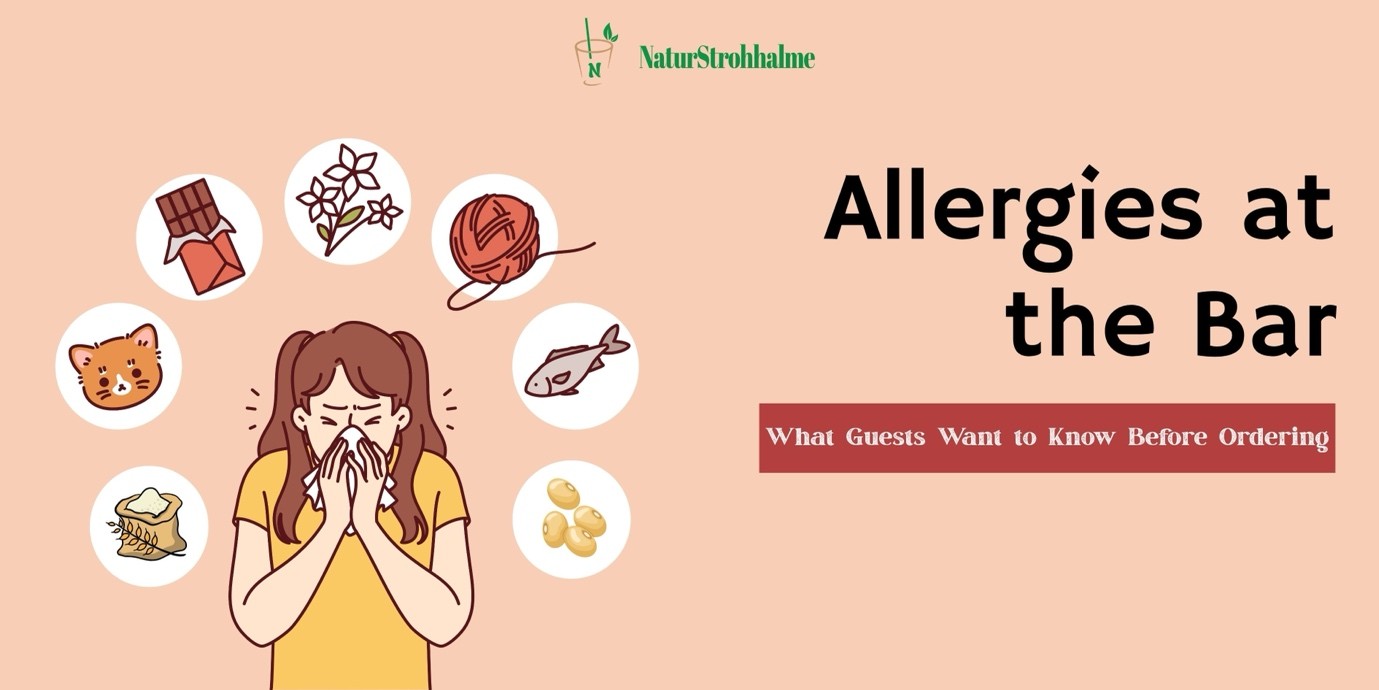
A guest sits down at your bar, glances at the cocktail menu and asks before ordering anything: “Does this contain gluten?” For your team, that’s routine by now. For you as the operator, it’s a question with real consequences, because the EU Food Information to Consumers Regulation requires you to provide information on the 14 major allergens, including for drinks served over the bar. What often gets overlooked: a cocktail isn’t just spirit, syrup and fruit. For the guest, everything in the glass is part of the answer, straw included.
Why this question comes up so naturally now
Many guests with coeliac disease, wheat allergies or intolerances ask before they order, not after. There are good reasons for that:
- They often know their triggers better than the staff preparing the drink.
- Many have been given a wrong answer before and would rather ask twice.
- They expect a bar that pays attention to detail to be just as precise about ingredients.
For your team, that means a quick, correct answer builds trust. An uncertain answer, a shrug or a “should be fine” can trigger a real health reaction in the worst case. When it matters, what counts is what you actually know when a guest asks.
The straw is part of the answer
Legally, the straw isn’t an ingredient of the drink. For a guest with coeliac disease that makes little difference, because the straw sits in the glass. Many venues have switched to more sustainable straws in recent years without checking closely what they’re made of. Some straws on the market are made from durum wheat semolina, so-called pasta straws. They contain gluten and aren’t suitable for guests with coeliac disease, even when they’re marketed as sustainable. If you can’t give your team a clear answer, the risk shifts to the exact moment at the bar when there’s the least time to look it up.
That’s where it pays to check your own supply chain:
- What is the straw your bar uses actually made from?
- Do you have written information on it from the manufacturer?
- Does your team know the answer without having to check first?
This isn’t a theoretical problem. When venues switch to an alternative, the decision often comes down to look, price and lead time, and the ingredient list becomes an afterthought. For most guests that makes no difference. For a guest with coeliac disease, it can be the difference between a relaxed evening and a real problem.
What’s actually in NaturStrohhalme
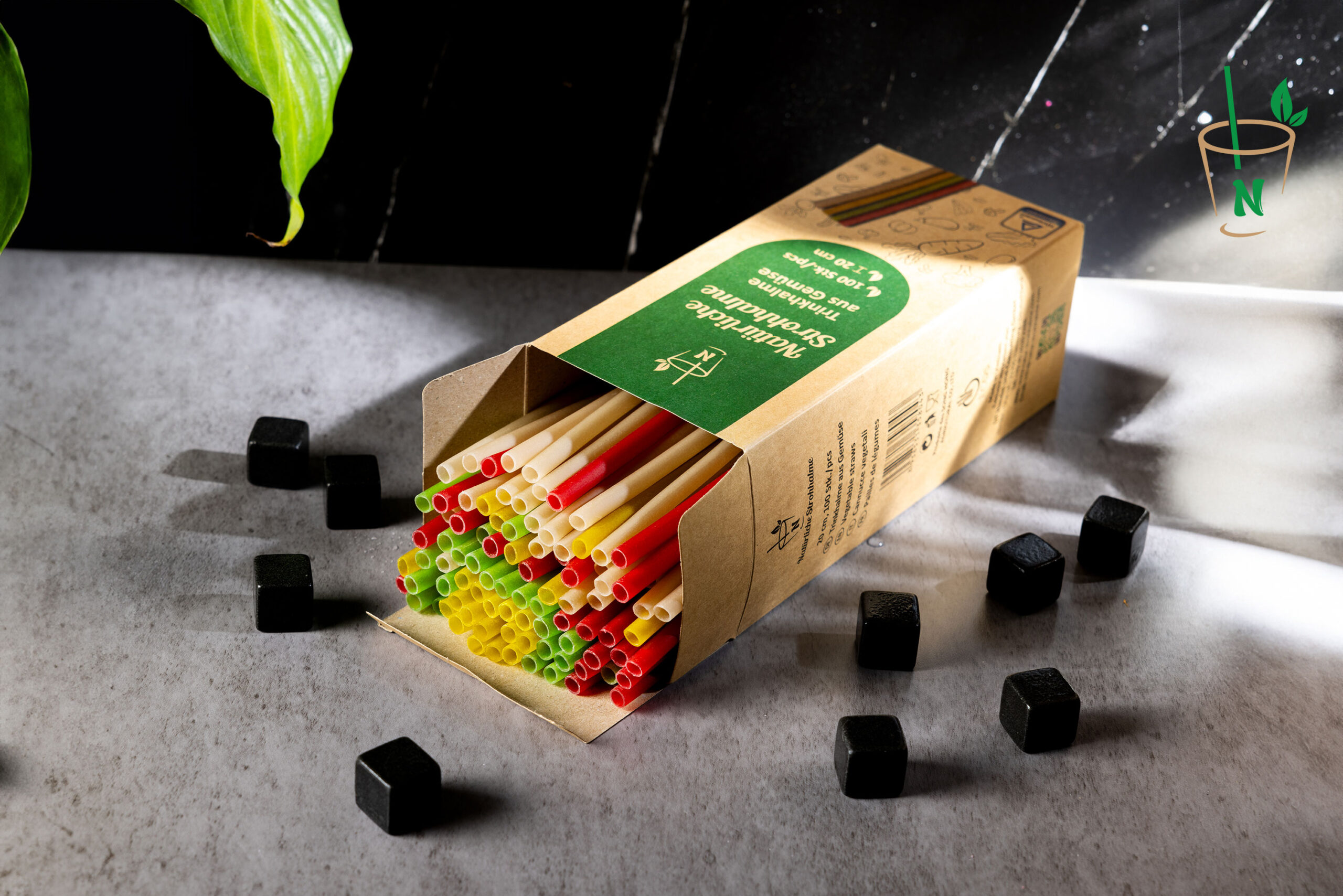
Our straws are made from 57 % tapioca starch and 42 % arrowroot flour, and the coloured straws add 1 % natural colour. The white straw contains 57 % tapioca starch and 43 % arrowroot flour. Tapioca and arrowroot come from root tubers, not from grain. For your operation, that means:
- Gluten-free: suitable for guests with coeliac disease
- Vegan, with the V-Label
- Flavour-neutral, the cocktail tastes the way it should
- Shape-stable for up to 2 hours in cold drinks
- Tested against EU food contact requirements
- Uncoated, so no typical PFAS source
You’ll need these facts most in one moment: when a guest asks at the bar. If you have questions about any of them, get in touch with us directly.
Quick answers for your team
So nobody has to improvise at the bar, a few fixed lines cover the most common questions:
- “Is the straw gluten-free?” Yes, it’s made from tapioca starch and arrowroot flour, both gluten-free.
- “Is it vegan?” Yes, it carries the V-Label.
- “Any plastic or PFAS in it?” It’s made from plant starch, with no plastic and no coating, so there’s no typical PFAS source.
- “Does it go soft in the drink?” It stays shape-stable in cold drinks for up to two hours.
Four lines, easy to remember. That’s what a bar sounds like when it’s ready for the question.
More than a line on the menu
Over 95 % of our orders come from hospitality businesses that reorder roughly every three months. For many bars and hotels, the straw is a fixed part of their standard, like the glass or the garnish. Nobody mentions it on a normal night. On the night a guest actually asks, it decides between a confident answer and an awkward pause.
For your menu, that also means you don’t need a note on every single cocktail. It’s enough that your team knows the answer to “gluten-free”, “vegan” or “PFAS” is the same for every glass, whichever drink is being made. For a side-by-side look at straw materials, see our honest straw comparison.
A guest who knows what they’re drinking comes back and doesn’t need to ask next time.
Ready to switch your business to straws made from real vegetables? Uncoated and tested against EU food contact requirements.
St. Martin and the art of sharing: an old idea for a new kind of hospitality
In early November, darkness falls early. And then, on an evening around 11 November, they...
Read morePaper straws: less green than you think. What a study from South Korea shows
When the plastic straw disappeared from Europe’s bars in July 2021, the paper straw was...
Read moreMicroplastics in the glass: what research says about beverages
A guest orders a still water, you serve it in a clean glass, nothing looks...
Read moreGuests with allergies at the bar: what they ask before they order
A guest sits down at your bar, glances at the cocktail menu and asks before...
Read moreCreative Halloween Decor with NaturStrohhalme: Have You Thought of This Yet?
For many bars and restaurants, Halloween is the one time of year when decor matters...
Read moreFederweißer, pumpkin, apple: the autumn menu 2026
Evenings are getting cooler, guests are trading Aperol for something warmer, and suddenly your bar...
Read moreA short history of the drinking straw, up to the natural straw
Some words give away their own origin, and the German word for drinking straw, „Strohhalm”,...
Read more57 % tapioca, 42 % arrowroot: what’s actually inside the straw
There’s one question almost every buyer asks us before placing a first pallet order: “So...
Read more