
Since the EU ban on single-use plastic straws, businesses have had a choice between several alternatives, paper straws and straws made from plant-based materials chief among them. At first glance the decision looks simple. Paper is familiar, cheap to source and listed by nearly every wholesaler. Look closer and it becomes clear that one paper straw is not the same as the next. And the question that matters in daily service is almost never the unit price. It is this: which straw actually holds up at the bar? An honest comparison is worth the effort, above all for businesses going through hundreds of straws a day.
Stability depends on the individual straw, not on the material alone
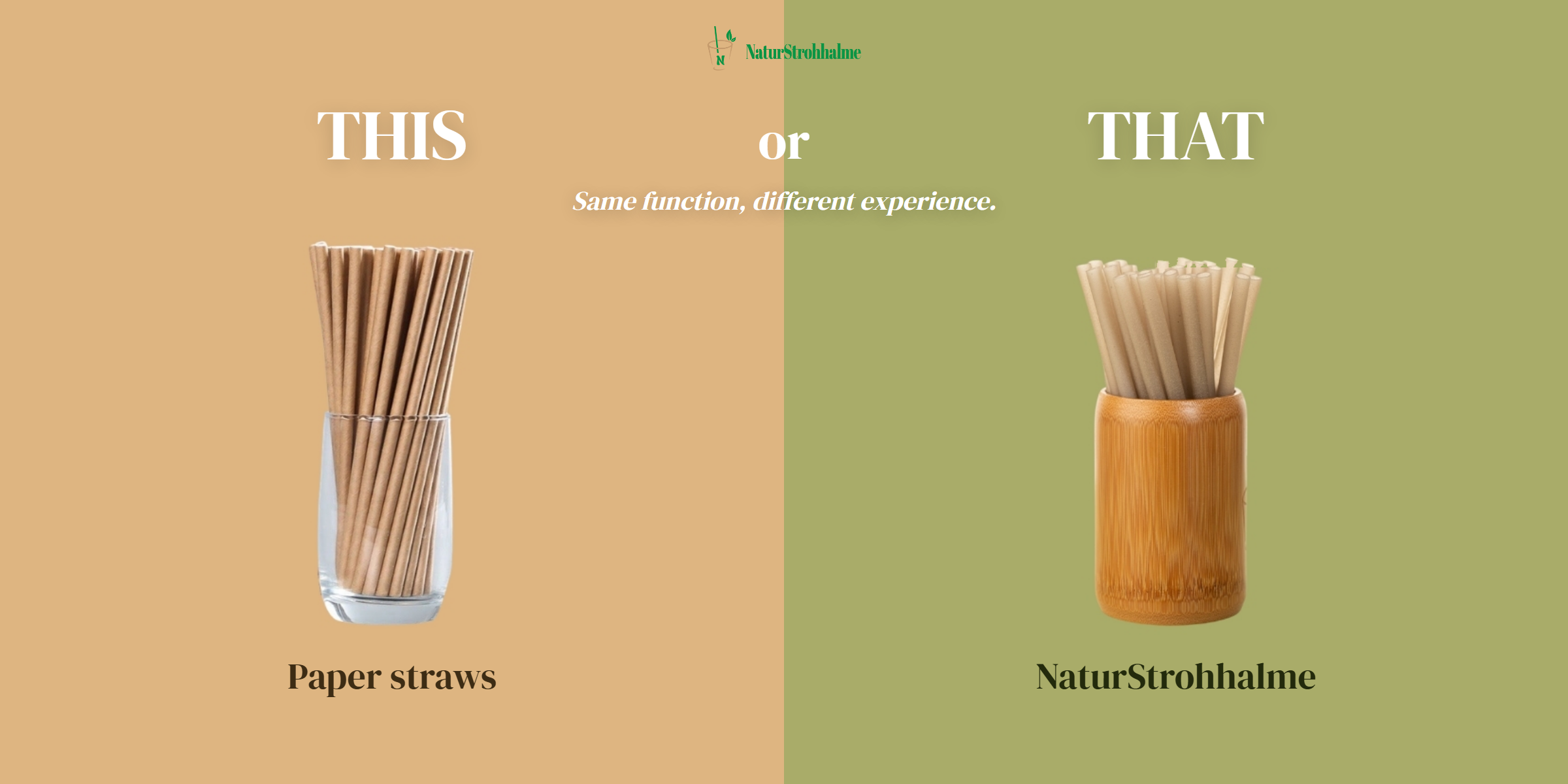
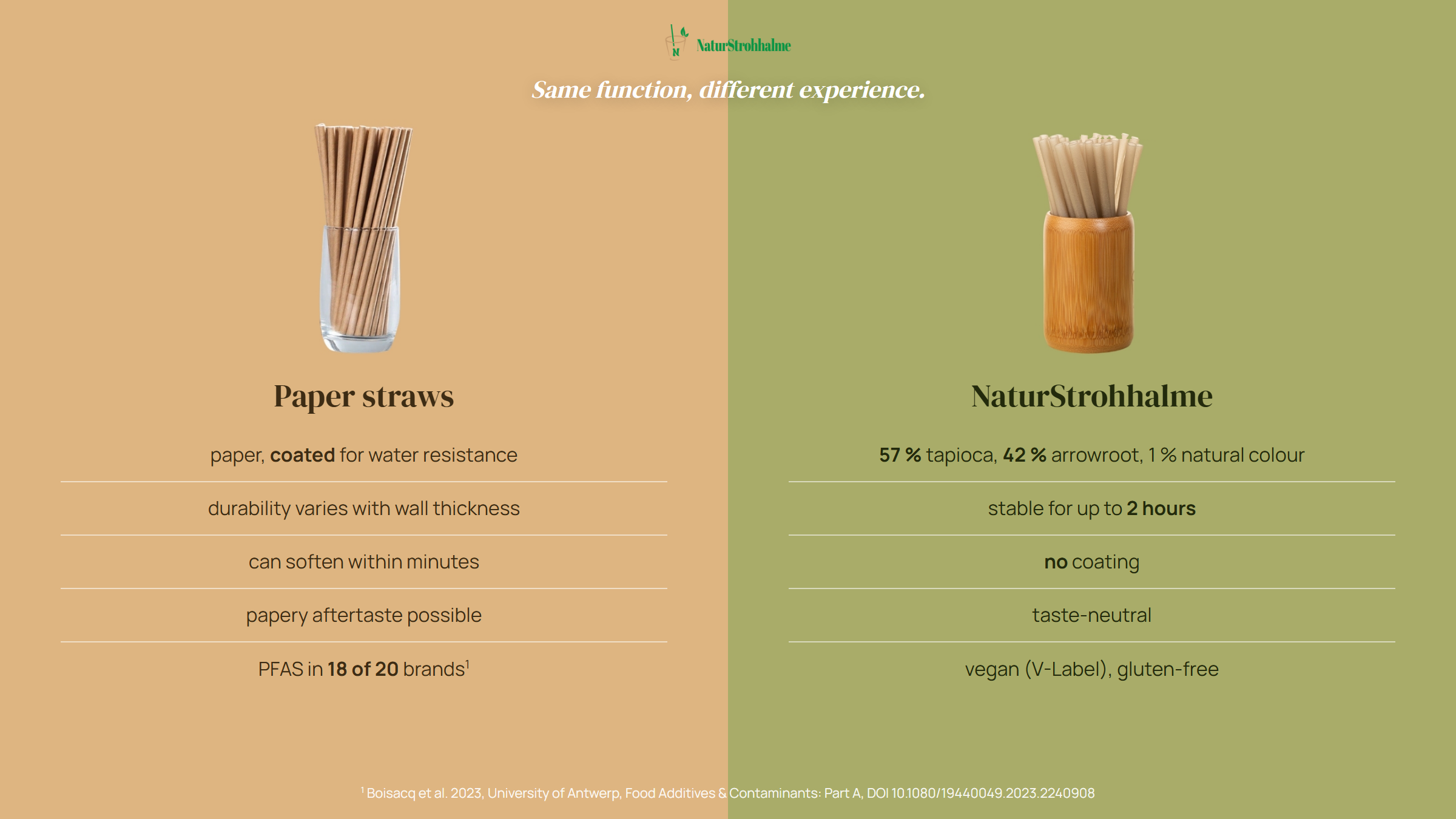
Paper straws vary widely. Thin-walled versions often soften in cold drinks within a short time. Thicker, double-walled ones hold up longer. Exactly how long depends on paper thickness, coating and the drink itself. A spritz loaded with ice stresses a straw differently than a still soft drink. That makes paper a material category with a wide range rather than a reliable constant.
The real risk sits with the thin, barely coated versions. Once a straw like that softens, the guest reaches for a second or a third. That is a reflex, not an exception. Run the numbers for your own venue: if only every fourth guest takes a second straw, consumption rises by 25 percent. That item never shows up on a paper straw invoice. It still hits the books at the end of the month.
NaturStrohhalme are made from 57 % tapioca and 42 % arrowroot, plus 1 % natural colour. The uncoloured white version comes in at 57 % tapioca and 43 % arrowroot. In cold drinks they stay stable for up to 2 hours, no matter how long a guest lingers over a drink. For the business that means a property you can plan with, instead of a figure that shifts from batch to batch.
Taste nobody wants in their drink
One thing price comparisons tend to miss: paper can pass on taste, especially after prolonged contact with liquid or with the coatings meant to make the straw waterproof. It shows up faster in a gin and tonic or a light white wine spritz than in sweet, heavily flavoured drinks.
NaturStrohhalme are taste-neutral. The straw stays in the background and the drink tastes the way your bar mixed it.
Coating is the real sticking point
For a paper straw to become waterproof at all, it needs a coating. That is exactly where a study from the University of Antwerp comes in. Researchers tested 39 straw brands across five materials. PFAS residues were found in 18 of 20 paper straw brands and in 4 of 5 bamboo straw brands, likely from that same water-repellent coating (Boisacq et al., 2023, Food Additives & Contaminants: Part A, DOI 10.1080/19440049.2023.2240908). That is not a reason to panic. It is a reason to look closer at straw choice instead of relying on the word “sustainable” on the label. How PFAS ends up in a drinking straw in the first place is covered in detail in the PFAS overview.
NaturStrohhalme come without any coating. That removes the typical source through which PFAS ends up in other straws. On top of that come properties that matter in day-to-day service:
- tested against the EU food contact requirements (Regulation (EC) 1935/2004 and (EU) 10/2011)
- vegan under the V-Label
- gluten-free
- no plastic content
What happens after service
Paper is generally assumed to be unproblematic to dispose of. In practice, many coated paper straws need industrial composting facilities that are not available everywhere. NaturStrohhalme carry no coating. Where the straw goes after use is set by your waste contractor, and local regulation decides the details, so a quick look at the rules in your area is worth it.
What the guest actually notices
At the bar, the guest’s experience is what counts in the end. A straw that lasts the whole time someone is drinking, without softening or passing on taste, simply goes unnoticed. That is exactly the goal. When it does get noticed, because a thin paper straw gives out after ten minutes, a small detail turns into a moment the guest remembers.
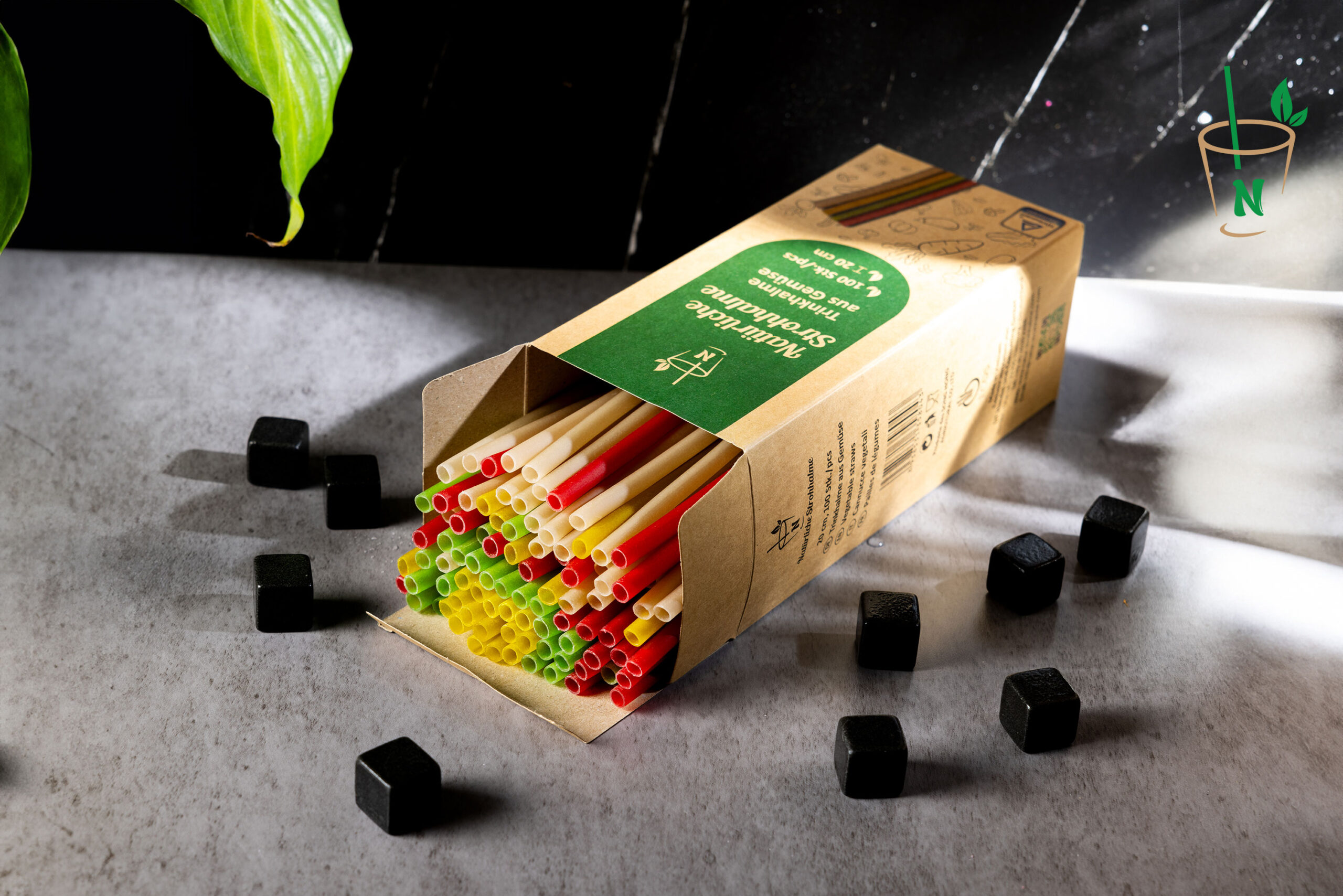
There is a visual side to it as well. NaturStrohhalme come in four colours made from real ingredients, with no artificial dyes:
- White (natural) for a clean, versatile look
- Yellow (turmeric) for tropical drinks
- Red (beetroot) for bold, fruit-forward cocktails
- Green (pandan leaves) for fresh highballs
According to our own order data, the Ø 8 × 20 cm is the best-selling format in the hospitality trade. One diameter covers most of the menu, from soft drinks to smoothies. For cocktails in short glasses, the Ø 8 × 15 cm is the better fit.
Asking the right question
Paper and vegetable straws cannot be reduced to a single number. Anyone making the choice does well to look past the unit price: at what holds up at the bar, and at what stays unnoticed in the drink. For an overview of every common material, see the straw comparison.
Frequently asked questions
Do paper straws get more stable the thicker they are?
Thicker, double-walled paper straws generally hold up longer than thin-walled ones. Exactly how long also depends on the coating and on the drink. That is why there is no fixed time figure for paper.
Why is there PFAS in paper straws?
Paper is not waterproof by nature, so it is coated. The University of Antwerp study (Boisacq et al., 2023) found PFAS residues in 18 of 20 paper straw brands and traces them back to that water-repellent coating.
What are NaturStrohhalme made of?
57 % tapioca and 42 % arrowroot, plus 1 % natural colour from turmeric, beetroot or pandan leaves. The white version comes without colour and is made of 57 % tapioca and 43 % arrowroot. They carry no coating.
How long does a NaturStrohhalm stay stable in the glass?
Up to 2 hours in cold drinks. That holds for cocktails with plenty of ice as well.
Which size suits hospitality use?
The Ø 8 × 20 cm is our best-selling format, because one diameter covers most of the drink menu. For cocktails in short glasses, the Ø 8 × 15 cm is a useful addition.
Paper or plant for your venue?
Order now: all four sizes and colours, also as a mixed set to try out.
Bulk quantities and trade terms: le@natur-strohhalme.com
Ready to switch your business to straws made from real vegetables? Uncoated and tested against EU food contact requirements.
St. Martin and the art of sharing: an old idea for a new kind of hospitality
In early November, darkness falls early. And then, on an evening around 11 November, they...
Read morePaper straws: less green than you think. What a study from South Korea shows
When the plastic straw disappeared from Europe’s bars in July 2021, the paper straw was...
Read moreMicroplastics in the glass: what research says about beverages
A guest orders a still water, you serve it in a clean glass, nothing looks...
Read moreGuests with allergies at the bar: what they ask before they order
A guest sits down at your bar, glances at the cocktail menu and asks before...
Read moreCreative Halloween Decor with NaturStrohhalme: Have You Thought of This Yet?
For many bars and restaurants, Halloween is the one time of year when decor matters...
Read moreFederweißer, pumpkin, apple: the autumn menu 2026
Evenings are getting cooler, guests are trading Aperol for something warmer, and suddenly your bar...
Read moreA short history of the drinking straw, up to the natural straw
Some words give away their own origin, and the German word for drinking straw, „Strohhalm”,...
Read more57 % tapioca, 42 % arrowroot: what’s actually inside the straw
There’s one question almost every buyer asks us before placing a first pallet order: “So...
Read more