
A guest orders a still water, you serve it in a clean glass, nothing looks suspicious. Meanwhile, big numbers and even bigger headlines circulate about microplastics in drinks, and few of them name a source. If you decide every day what goes into the glass, the studies themselves are worth a look. One thing upfront: panic is the worst response here, curiosity the far more useful one.
The number that made waves in 2024
In January 2024, a Columbia University team published an analysis of bottled water from three US brands in the Proceedings of the National Academy of Sciences (PNAS): an average of roughly 240,000 plastic particles per litre, ranging from 110,000 to 370,000 per sample. About 90 percent were nanoplastics.
That is 10 to 100 times more than earlier estimates. The jump says less about dirtier water than about better instruments, since earlier measurements mainly captured larger particles. Only a new microscopy technique based on stimulated Raman scattering (SRS) made it possible to chemically identify particles down to around 100 nanometres. The team found polyamide more often than PET from the bottle, probably from the plastic filters used to purify the water.
A study that surprised a lot of people
In 2025, a team at the French agency ANSES published measurements of microplastics in drinks from glass and plastic bottles, cans and cartons. The averages by type of drink:
- Water: 2.9 particles per litre
- Wine: 8.2 particles per litre
- Iced tea: 28.5 particles per litre
- Cola: 31.4 particles per litre
- Lemonade: 45.2 particles per litre
- Beer: 82.9 particles per litre
Drinks in glass bottles were the most contaminated. Cola, lemonade, iced tea and beer from glass averaged around 100 particles per litre, five to fifty times more than from plastic bottles or cans. Before anyone cancels their bottle delivery, the cause is worth a closer look: the shape, colour and polymer composition of the particles matched the paint on the outside of the metal caps. The glass itself was not the source.
That is also why the effect can be reduced. In one trial, levels fell from 287 to 106 particles per litre after the caps were blown with compressed air, and to 87 particles per litre when they were rinsed as well. According to ANSES, it is not possible to say whether these levels pose a health risk, as toxicological reference values are lacking.
The study did not go unchallenged. The European container glass federation FEVE stressed that, according to the study, the particles came from the caps and not from the glass. Researchers led by Jane Muncke of the Food Packaging Forum argued in a published comment that normalising per litre makes small bottles look more contaminated.
The order of magnitude belongs in the picture too: here we are talking about a few dozen particles per litre, at Columbia about hundreds of thousands. Different methods, different measurement ranges, so the figures are not directly comparable. Wine, incidentally, stayed low, even in glass bottles with corks.
What the authorities say
There is currently no final answer to the question “Is this dangerous?”
- BfR, German Federal Institute for Risk Assessment (December 2025): according to current scientific knowledge, microplastics are more likely to pose a low health risk to humans. A causal link to specific diseases has not been established, and more research is needed. Many studies rely on small samples, and there are no internationally standardised detection methods yet.
- EFSA: a full risk assessment of microplastics and nanoplastics in food has not yet been completed. For that reason, the agency cannot currently conclude on potential health effects.
A low risk does not mean every question has been answered. One observational study in the New England Journal of Medicine (2024) drew a lot of attention: in 150 of 257 patients followed up, or 58 percent, micro- and nanoplastics, mainly polyethylene, were found in carotid artery plaque. Over the following 34 months or so, that group was more likely to have a heart attack or stroke, or to die. An observational study cannot prove cause and effect. It is a reason to keep researching, not a reason to rebuild your operation.
The straw: small item, direct contact
With the straw things get more concrete, since it often sits in the drink for minutes. In 2023, a group led by Thimo Groffen at the University of Antwerp tested 39 straw brands made from five materials for PFAS and published the results in Food Additives & Contaminants. The substances were detectable in:
| Material | Brands with PFAS | Share |
|---|---|---|
| Paper straws | 18 of 20 | 90 % |
| Bamboo straws | 4 of 5 | 80 % |
| Plastic straws | 3 of 4 | 75 % |
| Glass straws | 2 of 5 | 40 % |
| Stainless steel straws | 0 of 5 | 0 % |
In total, 27 of the 39 brands contained PFAS. Whether the substances were added on purpose or got in as contamination, for example via soil or process water, is not known. Because they turned up in almost every paper brand, the researchers consider a water-repellent coating likely in some cases. Two of the compounds found, TFA and TFMS, are highly water-soluble and might leach into the drink. Concentrations were low, and with occasional use the authors see a limited risk. What remains notable is that the paper straw, marketed as the sustainable option, showed up most often. More on this in our article on paper straws or vegetable straws.
Where NaturStrohhalme come in
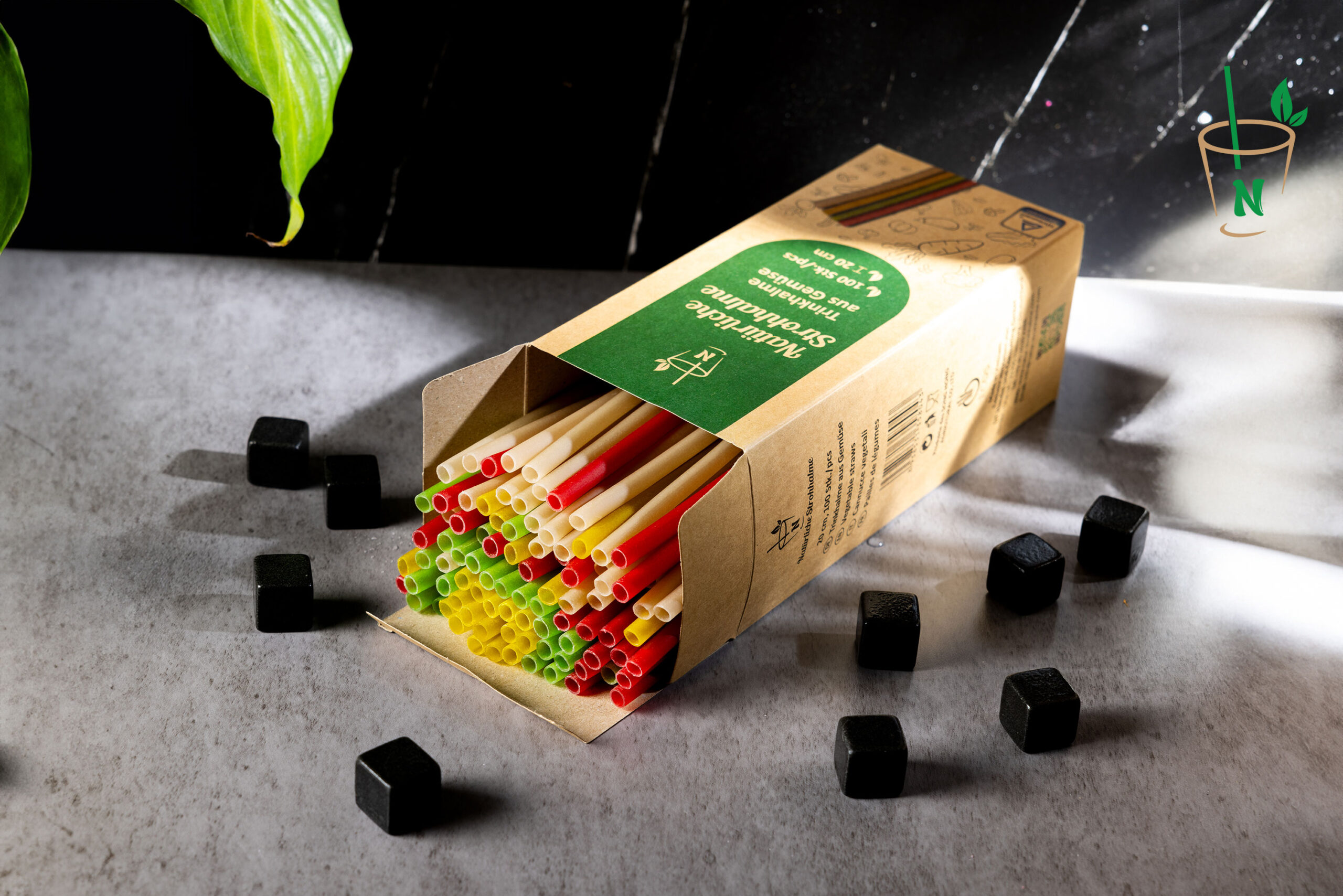
Our straws are made of 57 % tapioca starch and 42 % arrowroot flour, with 1 % natural colour in the coloured versions. The white straw contains 57 % tapioca starch and 43 % arrowroot flour. The straws have no coating and are therefore not a typical PFAS source. They are tested against EU requirements for food contact materials.
- vegan (V-Label) and gluten-free
- flavour-neutral, no taste of its own in the drink
- holds its shape for up to 2 hours in cold drinks
- single-use, no cleaning needed
Plus four colours made from real ingredients: white (natural), yellow (turmeric), red (beetroot) and green (pandan). A red straw in a fruit-forward cocktail, a green one in a cucumber gimlet. From our own order data: Ø 8 × 200 mm is our most-ordered size in hospitality.
Sources
- Qian et al. (2024): Rapid single-particle chemical imaging of nanoplastics by SRS microscopy. PNAS. Columbia Public Health
- Chaïb et al. (2025): Microplastic contaminations in a set of beverages sold in France. Journal of Food Composition and Analysis. ANSES
- FEVE (2025): European container glass industry response to the ANSES study. feve.org
- Muncke et al. (2025): Comment on Chaïb et al., Journal of Food Composition and Analysis. Food Packaging Forum
- BfR (2025): Mitteilung 055/2025, Mikroplastik: Diskrepanz zwischen wissenschaftlichem Kenntnisstand und öffentlicher Wahrnehmung (German). bfr.bund.de
- EFSA: Microplastics and nanoplastics in food. efsa.europa.eu
- Marfella et al. (2024): Microplastics and Nanoplastics in Atheromas and Cardiovascular Events. New England Journal of Medicine. nejm.org
- Groffen et al. (2023): Assessment of poly- and perfluoroalkyl substances (PFAS) in commercially available drinking straws. Food Additives & Contaminants: Part A. tandfonline.com
Ready to switch your business to straws made from real vegetables? Uncoated and tested against EU food contact requirements.
St. Martin and the art of sharing: an old idea for a new kind of hospitality
In early November, darkness falls early. And then, on an evening around 11 November, they...
Read morePaper straws: less green than you think. What a study from South Korea shows
When the plastic straw disappeared from Europe’s bars in July 2021, the paper straw was...
Read moreMicroplastics in the glass: what research says about beverages
A guest orders a still water, you serve it in a clean glass, nothing looks...
Read moreGuests with allergies at the bar: what they ask before they order
A guest sits down at your bar, glances at the cocktail menu and asks before...
Read moreCreative Halloween Decor with NaturStrohhalme: Have You Thought of This Yet?
For many bars and restaurants, Halloween is the one time of year when decor matters...
Read moreFederweißer, pumpkin, apple: the autumn menu 2026
Evenings are getting cooler, guests are trading Aperol for something warmer, and suddenly your bar...
Read moreA short history of the drinking straw, up to the natural straw
Some words give away their own origin, and the German word for drinking straw, „Strohhalm”,...
Read more57 % tapioca, 42 % arrowroot: what’s actually inside the straw
There’s one question almost every buyer asks us before placing a first pallet order: “So...
Read more