
July 2021. From that month on, the colourful plastic straw that had been sitting in every long drink for decades could no longer be placed on the market. Existing stock could still be sold, and after that it gradually disappeared from the counters. The EU Single-Use Plastics Directive (SUP Directive for short) took it off the market, and Germany put it into practice with its Single-Use Plastics Ban Ordinance. Five years on, it is worth taking an honest look across the counter. Which alternatives have stood the test of time? And what are bar teams still struggling with today?
What the ban actually covers
Since 3 July 2021, certain single-use plastic products may no longer be placed on the market in the EU. For the hospitality industry, the most noticeable ones were:
- Straws and stirrers
- Disposable cutlery and plates
- Food and drink containers made of expanded polystyrene
- Balloon sticks, in case your event venue likes to decorate
One detail surprised many people at first: the directive does not ask whether the plastic comes from crude oil or from plants. Bio-based plastics are covered too. Later on, exactly this became a stumbling block for one of the most popular alternatives.
Paper: well meant, quickly soggy
The paper straw was the industry’s first answer and, for many businesses, the most convenient one. Available, cheap and somehow green. In day-to-day bar service, though, its weaknesses showed up fast:
- It goes soft after a while, especially in acidic drinks or with lots of crushed ice.
- Many guests notice a papery aftertaste.
- To hold together at all, it needs glue and often a coating.
That last point is about more than taste. In 2023, researchers at the University of Antwerp tested straws made from various materials for PFAS, the so-called forever chemicals (study at tandfonline.com). They were detected in 18 of the 20 paper straw brands tested. The sample was small and the concentrations were low. Even so, the image of the clean paper straw has taken a real hit since then, and for businesses that promise their guests sustainability, that is uncomfortable news. You’ll find a detailed comparison in our article paper straws or vegetable straws.
Reusable glass and stainless steel: lovely in the catalogue, hard work in practice
Anyone who wanted to drop single-use entirely turned to straws made of glass or stainless steel. The idea sounds appealing: buy once, use for years. At a busy bar, however, each material reveals its own drawbacks.
Glass
- One knock against the rim of a glass or a crowded dishwasher rack is enough, and the straw breaks. Shards in a drink are a real safety risk.
- Hardly suitable for pool bars, terraces or families with kids.
- High price per piece, plus ongoing losses through breakage.
Stainless steel
- It conducts cold extremely well. In a frozen margarita, the straw gets unpleasantly icy on the lips.
- Some guests dislike the metallic feel or the clink against their teeth.
- It is opaque, so nobody can see whether syrup or fruit purée is still stuck inside.
For both
- Every straw needs a brush for the inside, as a dishwasher alone often can’t manage it.
- You need a stock that makes up for shrinkage, because reusable straws are popular souvenirs.
For a cocktail bar serving hundreds of drinks on a Saturday night, that is rarely realistic.
PLA: organic on the label, plastic in the eyes of the law
PLA (polylactic acid) is usually made from corn starch or sugar cane, which is why it sounds natural. Under the SUP Directive, however, PLA is a plastic. As a single-use straw, it is therefore just as banned as the classic plastic straw. On top of that, PLA needs industrial conditions with high temperatures to break down in a reasonable time. In nature, it degrades only very slowly. If you still have leftover stock in your storeroom, it is worth taking a close look at the legal situation.
What has actually changed behind the bar
After five years, the picture is mixed. Awareness has grown: guests ask what their straw is made of, and bar teams pay closer attention. At the same time, many businesses have simply swapped one problem for another, such as soggy paper for questionable coatings, or single-use for reusables that eat up a lot of washing time behind the bar.
2027 will be interesting. By 3 July 2027, the European Commission has to evaluate the directive (Art. 15, Directive (EU) 2019/904), and it is quite possible that the replacement materials will come under closer scrutiny too.
Our approach: root starch instead of compromise
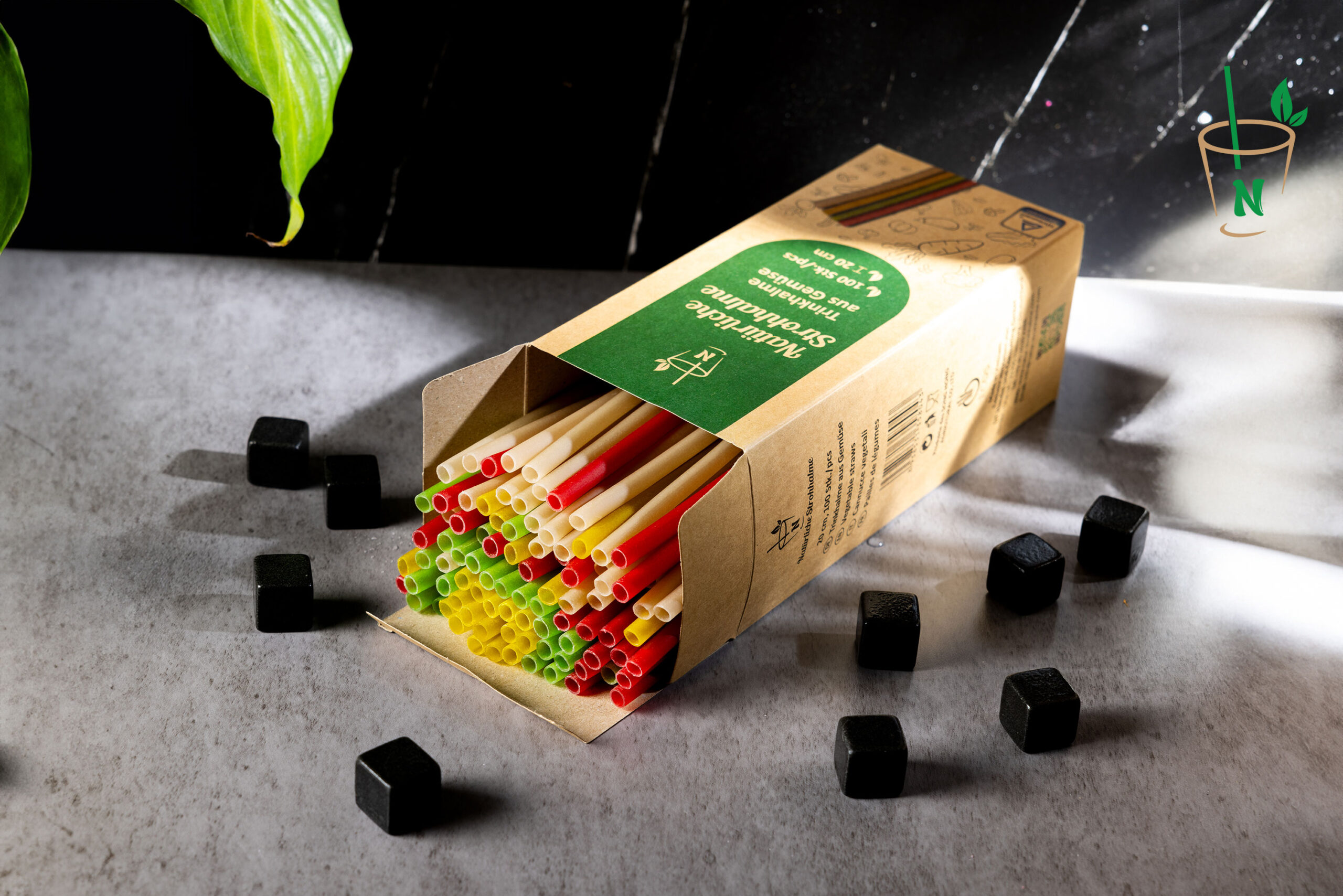
NaturStrohhalme are made from two plant-based ingredients: 57 % tapioca starch and 42 % arrowroot flour, plus 1 % natural colour. The white straw contains 57 % tapioca starch and 43 % arrowroot flour. No plastic, no paper and no coating. For your business, that means:
- Stays firm for up to 2 hours in cold drinks
- Neutral in taste, so your signature drink tastes like your signature drink
- No coating, and therefore no typical source of PFAS
- Vegan (V-Label) and gluten-free, a good fit for guests with coeliac disease
- Tested in line with EU requirements for food contact
- Single-use, so no washing up at all
The look is taken care of too. The straws come in four colours made from real ingredients: white (natural), yellow (turmeric), red (beetroot) and green (pandan). A red straw in a Negroni or a green one in a Gin Basil Smash looks planned, because it is.
| Size | Recommended for |
|---|---|
| Ø 6 × 200 mm | Long drinks, spritz, light cocktails |
| Ø 8 × 200 mm | Sours, fruity cocktails |
| Ø 8 × 150 mm | Caipirinhas and drinks with crushed ice |
| Ø 12 × 200 mm | Frozen drinks, shakes, smoothie cocktails |
Ø 8 × 200 mm is our most-ordered size in hospitality. And more than 95 % of our orders come from hospitality businesses that reorder roughly every three months. For us, that is the nicest compliment there is: many who switch once stay with it.
The ban got rid of the plastic straw; the better solution is yours to choose, one glass at a time.
Ready to switch your business to straws made from real vegetables? Uncoated and tested against EU food contact requirements.
Five years of the single-use plastics ban: what has really changed behind the bar
July 2021. From that month on, the colourful plastic straw that had been sitting in...
Read moreWhich straw for which winter drink? The size guide for the festive season
As soon as the first fairy lights go up outside, your menu starts to change...
Read moreSt. Martin and the art of sharing: an old idea for a new kind of hospitality
In early November, darkness falls early. And then, on an evening around 11 November, they...
Read morePaper straws: less green than you think. What a study from South Korea shows
When the plastic straw disappeared from Europe’s bars in July 2021, the paper straw was...
Read moreMicroplastics in the glass: what research says about beverages
A guest orders a still water, you serve it in a clean glass, nothing looks...
Read moreGuests with allergies at the bar: what they ask before they order
A guest sits down at your bar, glances at the cocktail menu and asks before...
Read moreCreative Halloween Decor with NaturStrohhalme: Have You Thought of This Yet?
For many bars and restaurants, Halloween is the one time of year when decor matters...
Read moreFederweißer, pumpkin, apple: the autumn menu 2026
Evenings are getting cooler, guests are trading Aperol for something warmer, and suddenly your bar...
Read more