When the plastic straw disappeared from Europe’s bars in July 2021, the paper straw was cast as its well-behaved successor. A little soft after twenty minutes, a faint taste of cardboard, but a clear conscience in the glass. In October 2026 that clear conscience took a proper dent. A life cycle assessment commissioned by South Korea’s Ministry of Climate, Energy and Environment, reported by The Korea Herald and the trade portal Packaging Insights among others, has come up with results that should give more than one bar menu pause for thought.
What the researchers looked at
From May 2025 to April 2026, the Korean Society for Life Cycle Assessment followed single-use straws through their entire life, from production to disposal. The baseline was a scenario in which 73.6 % of waste is incinerated and 26.4 % goes to landfill.
Four materials were compared:
- conventional plastic (polypropylene, PP)
- paper
- degradable plastic (e.g. PLA)
- bio-PE, a plastic made partly from bio-based sources
The study assessed 16 environmental impacts, including greenhouse gases, ozone depletion, acidification, carcinogenic potential for humans and particulate matter.
The figures that make you think
The result turns the usual assumption on its head. All values are measured against the classic plastic straw (PP):
- Ozone depletion: paper straws come in at 2.2 times PP, degradable plastic at 2.4 times, bio-PE at as much as 4 times.
- Carcinogenic potential: 6.33 times higher than PP for paper, 3.3 times for degradable plastic, 16 times for bio-PE.
- Particulate matter: paper causes 1.62 times as much, degradable plastic just under 2 times, bio-PE 12 times.
- Climate, acidification, particulate matter and human toxicity: here, of all things, the classic plastic straw performed best, in 10 of 16 categories overall.
One important point of context: the study measured risks from emissions along production and disposal. Anyone sipping through a paper straw is not taking in a sixfold dose of pollutants. The figures describe what a straw leaves behind in the air and the environment on its way through the factory and the incinerator.
The three materials side by side
Add earlier studies to the picture and it becomes fairly clear:
Plastic (PP)
- banned as a single-use straw in the EU since 2021
- ahead in several categories of the Korean life cycle assessment
- stays in the environment for a very long time as waste
Paper
- needs glue and often a coating to hold up in a drink
- in 2023, researchers at the University of Antwerp found PFAS in 18 of 20 paper straw brands tested (more on paper straws)
- according to researchers at Northeastern University and the Woods Hole Oceanographic Institution, production takes 10 to 100 times more water than for bioplastic
- in the Korean study, the material with the highest impact in 3 of 16 categories
Bioplastic (e.g. PLA, bio-PE)
- falls under the EU Single-Use Plastics Directive and is therefore banned as well
- bio-PE scored worst in 10 categories in the study, with the highest values for ozone depletion, carcinogenic potential and particulate matter
One finding applies to all of them equally: drinking straws are practically impossible to recycle. They are simply too small to be sorted out by machine or by hand in sorting plants, and they end up being incinerated.
Fewer straws, better chosen
The researchers draw a remarkably level-headed conclusion. A policy that bans only the plastic straw and leaves other single-use straws aside falls short. The most effective lever, they say, is to stop putting a straw in every glass automatically and to hand them out only on request.
For your bar, that translates well:
- Straw on request: with water, beer or a Negroni in a tumbler, hardly anyone misses it.
- Straw with a purpose: with crushed ice, frozen drinks, sours with foam or a Berliner Weisse, it simply belongs.
- Check the material: ask your supplier for the ingredient list, coating details and proof of food-contact compliance.
- Choose the right size: a straw that fits the glass gets bent, clogged or replaced less often.
That way you save material, money and discussions, and the straws that do go across the counter have truly earned their place.
Root starch as an honest alternative
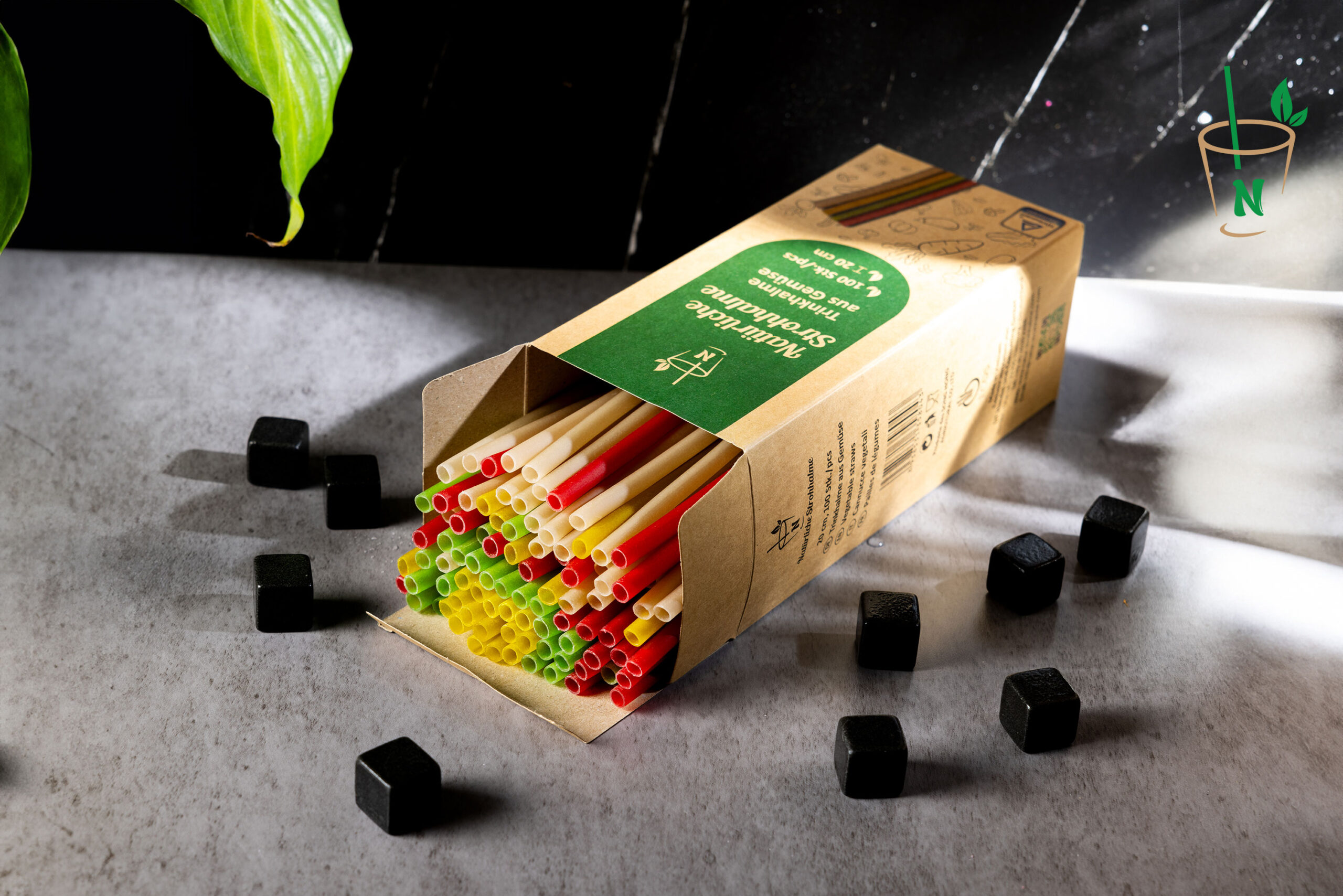
Let’s say it up front: straws made from root starch were not part of the Korean study, so we are deliberately not quoting any comparison figures here. What we can tell you is what goes into NaturStrohhalme: 57 % tapioca starch and 42 % arrowroot flour, plus 1 % natural colour. The white straw contains 57 % tapioca starch and 43 % arrowroot flour. No paper, no plastic, no glue.
For your business, that means:
- Uncoated, so no typical source of PFAS
- Vegan (V-Label) and gluten-free, suitable for guests with intolerances
- Neutral in taste, your signature drink stays your signature drink
- Holds its shape for up to 2 hours in cold drinks, crushed ice included
- Tested according to EU requirements for food contact
The four natural colours white (natural), yellow (turmeric), red (beetroot) and green (pandan) contain no artificial dyes. If there has to be a straw in the glass, it may as well look good.
| Size | Recommended for |
|---|---|
| Ø 6 × 200 mm | Long drinks, spritz, light cocktails |
| Ø 8 × 200 mm | Sours, fruit-forward cocktails |
| Ø 8 × 150 mm | Caipirinha and drinks with crushed ice |
| Ø 12 × 200 mm | Frozen drinks, shakes, smoothie cocktails |
Ø 8 × 20 cm is our most-ordered format in hospitality. Over 95 % of our orders come from hospitality businesses that reorder roughly every 3 months. It seems worth taking a closer look at this small detail.
The best straw is the one your guest actually needs, and after that, one you can tell them everything about.
Ready to switch your business to straws made from real vegetables? Uncoated and tested against EU food contact requirements.
St. Martin and the art of sharing: an old idea for a new kind of hospitality
In early November, darkness falls early. And then, on an evening around 11 November, they...
Read morePaper straws: less green than you think. What a study from South Korea shows
When the plastic straw disappeared from Europe’s bars in July 2021, the paper straw was...
Read moreMicroplastics in the glass: what research says about beverages
A guest orders a still water, you serve it in a clean glass, nothing looks...
Read moreGuests with allergies at the bar: what they ask before they order
A guest sits down at your bar, glances at the cocktail menu and asks before...
Read moreCreative Halloween Decor with NaturStrohhalme: Have You Thought of This Yet?
For many bars and restaurants, Halloween is the one time of year when decor matters...
Read moreFederweißer, pumpkin, apple: the autumn menu 2026
Evenings are getting cooler, guests are trading Aperol for something warmer, and suddenly your bar...
Read moreA short history of the drinking straw, up to the natural straw
Some words give away their own origin, and the German word for drinking straw, „Strohhalm”,...
Read more57 % tapioca, 42 % arrowroot: what’s actually inside the straw
There’s one question almost every buyer asks us before placing a first pallet order: “So...
Read more