
PFAS are everywhere—from non-stick pans to coated paper straws. Learn how to avoid “forever chemicals” in daily life and why natural straws are the healthy choice. 
PFAS in Everyday Life: Why Natural Straws are the Safest Choice for Your Drinks
Natural straws represent a small but powerful step toward reducing your personal exposure to so-called “forever chemicals” (PFAS). We often have to ask ourselves: “Are you sure you haven’t already consumed them?” In reality, PFAS enter our bodies unnoticed through drinking water, food, and everyday household products. Because these chemicals are extremely persistent and accumulate in human tissue over time, identifying and eliminating contaminated sources in your daily routine is crucial. In this article, we highlight where PFAS lurk and why switching to natural straws is one of the simplest and healthiest decisions for your home or business.
Where are PFAS Hiding in Our Daily Lives?
PFAS (per- and polyfluorinated alkyl substances) are found almost everywhere due to their water, grease, and dirt-repellent properties. Here are the most common sources we encounter daily: 1. Outdoor Clothing and Textiles Many rain jackets, hiking boots, and backpacks are coated with PFAS so that water simply beads off. Even stain-resistant carpets or upholstered furniture often contain these invisible helpers, which can enter the environment through skin contact or abrasion. 2. Cookware and Pans Classic non-stick coatings (such as Teflon) have long been a major source of PFAS. If these pans overheat or become scratched, chemical particles can loosen and migrate directly into our food. 3. Food Packaging and Drinking Straws This is a critical area because the chemicals come into direct contact with our mucous membranes. Many fast-food wrappers, pizza boxes, and—surprisingly—coated paper straws use PFAS to remain grease-resistant and stable. A paper straw that doesn’t get soggy in water has often been chemically treated to achieve that durability.
The Danger: “Forever Chemicals” in Our Bodies
The treacherous thing about PFAS is their persistence. Once ingested, they remain in the human bloodstream for years. Scientific studies link long-term exposure to several health risks:
- Weakening of the immune system
- Increased cholesterol levels
- Hormonal disruptions
- Impairment of liver function
Why natural straws come without any coating
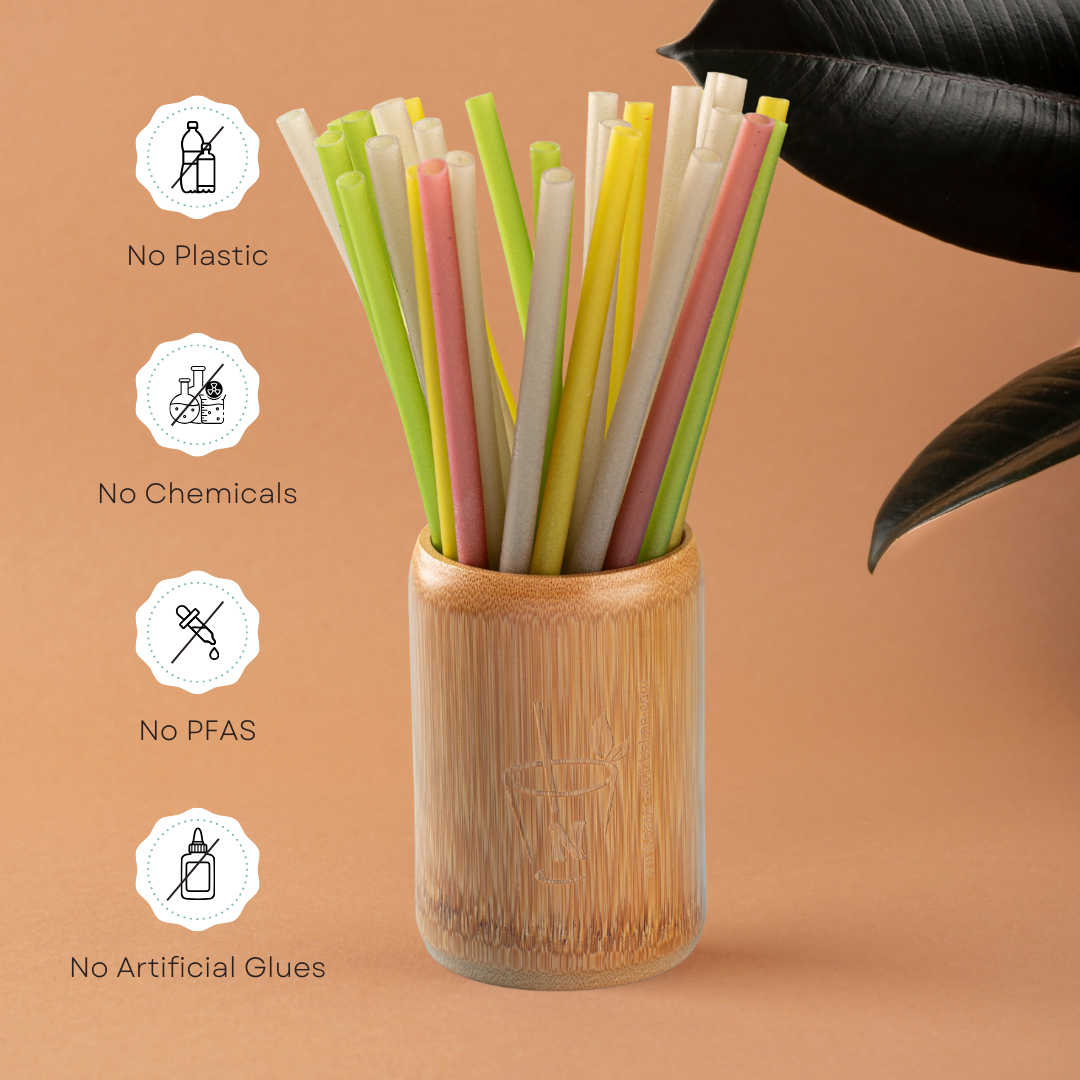 Our natural straws take a completely different approach. Instead of using synthetic chemistry to make paper waterproof, we utilize the inherent natural structure of the plant. Your Advantages with Natural Straws:
- No Chemical Coating: Since our straws are made from raw materials like tapioca, they require no PFAS sealing to remain stable in a drink.
- Ingredient Transparency: We rely on purely plant-based materials that are food-safe and even edible.
- Eco-Friendly Cycle: PFAS contaminate soil and groundwater for centuries. Natural straws are made from tapioca and arrowroot starch instead.
- Safety for Children: Especially for children, whose bodies are more sensitive to pollutants, our straws offer a risk-free drinking experience.
Tips: How to Reduce PFAS in Your Life
While it is nearly impossible to avoid PFAS entirely, you can significantly lower your exposure:
- Stainless Steel over Coating: Use pans made of cast iron, stainless steel, or ceramic.
- Conscious Textile Choices: Look for “PFAS-free” or “PFC-free” labels when buying outdoor gear.
- Caution with Disposable Tableware: Avoid coated paper plates and grease-proof paper bags.
- The Straw Check: Replace paper or plastic straws with natural straws. They are sturdy, food-safe and made without any coating.
Conclusion: A Conscious Sip into a Healthy Future
PFAS are a global problem, but the solution starts with small, individual choices. By choosing natural straws, you serve a drink with a straw made from tapioca and arrowroot starch, without any coating. Those who choose natural alternatives know what the material in their glass is made of. Ready to make the switch to uncoated straws? Try our natural straws and enjoy your drinks with a clear conscience!
St. Martin and the art of sharing: an old idea for a new kind of hospitality
In early November, darkness falls early. And then, on an evening around 11 November, they...
Read morePaper straws: less green than you think. What a study from South Korea shows
When the plastic straw disappeared from Europe’s bars in July 2021, the paper straw was...
Read moreMicroplastics in the glass: what research says about beverages
A guest orders a still water, you serve it in a clean glass, nothing looks...
Read moreGuests with allergies at the bar: what they ask before they order
A guest sits down at your bar, glances at the cocktail menu and asks before...
Read moreCreative Halloween Decor with NaturStrohhalme: Have You Thought of This Yet?
For many bars and restaurants, Halloween is the one time of year when decor matters...
Read moreFederweißer, pumpkin, apple: the autumn menu 2026
Evenings are getting cooler, guests are trading Aperol for something warmer, and suddenly your bar...
Read moreA short history of the drinking straw, up to the natural straw
Some words give away their own origin, and the German word for drinking straw, „Strohhalm”,...
Read more57 % tapioca, 42 % arrowroot: what’s actually inside the straw
There’s one question almost every buyer asks us before placing a first pallet order: “So...
Read more