
Our vegetable straws weren’t developed by a big corporation. Not in a high-tech lab, not with millions in funding. They came from the field. They began with a simple observation — and a question that kept coming back: how can we reduce the plastic waste created every single day? Behind every straw there is more than a product. It is the story of an idea that proves big change sometimes starts with a single thought.
An observation that changed everything
The story begins in Đông Anh, a rural region near Hanoi in Vietnam. There lived Lê Văn Tám, a farmer with an unusual way of looking at the world. Again and again, vegetables were left over: beetroot, sweet potatoes, carrots, pandan. Healthy food that nobody bought — tonnes of it had to be thrown away. At the same time, he watched cafés, restaurants and supermarkets use millions of plastic straws every day, only to bin them after a few minutes. A throwaway product that takes hundreds of years to break down. Two images he couldn’t shake. Wasted vegetables on one side, plastic waste on the other. And then a thought, so simple it almost sounded mad: why not make straws from vegetables? Natural. Edible. That is how the journey of our vegetable straws began.
From idea to experiment
Having an idea is easy. Making it real is the hard part. Lê started experimenting — without a big lab, without big machines. Just curiosity, patience and what nature gave him. He tested combinations of plant starch, natural plant fibres and colours from vegetables like beetroot and turmeric. His goal was clear: a straw that is completely natural and still works in everyday life.
The first straws — and their failure
The first attempts looked promising. But as soon as the straws were actually used, the problems showed: some dissolved in water after a short while, others snapped at the first sip, and a few left an off-taste in the drink. Weeks of work often ended the same way — crates full of failed straws in the bin. Friends called him mad. Relatives asked why he didn’t just stick to farming. But the idea wouldn’t let him go.
The high price of a dream
Innovation sometimes demands real sacrifice. To keep researching, Lê took out loans. Machines were sold to fund new trials. In the end, even three houses were put up as security for bank loans. For his family it was a time of deep uncertainty. Everything was on the line. But for him it was clear: if he could develop plastic-free vegetable straws, it could make a real difference — not just for his village, but for the environment.
The moment that could have ended it all
After countless attempts, the breakthrough finally seemed within reach. The recipe worked, the straws were stable. Soon after came a big opportunity: an order from Europe. Thousands of straws were produced and exported to England — a moment of great hope. But the European winter brought an unexpected test. Temperatures of –15 to –20°C hit the straws hard during transport. A large part of the shipment fell apart before it even reached the customer. In the end, the whole delivery was sent back. For a small business, that was a heavy financial blow. Many would have given up here. Lê chose to carry on — to start over once more.
The breakthrough after years of searching
During this difficult time, Lê presented his idea on the TV show Shark Tank Vietnam. He won over the investors not only with passion, but also secured funding from experienced industry experts. The greatest gain, though, wasn’t the money — it was the know-how. Advice on production, materials and durability helped perfect the technology. At last came the vegetable straw that met every demand: stable, taste-neutral, heat- and cold-resistant, made from tapioca and arrowroot starch.
Vegetable straws today: a refined product
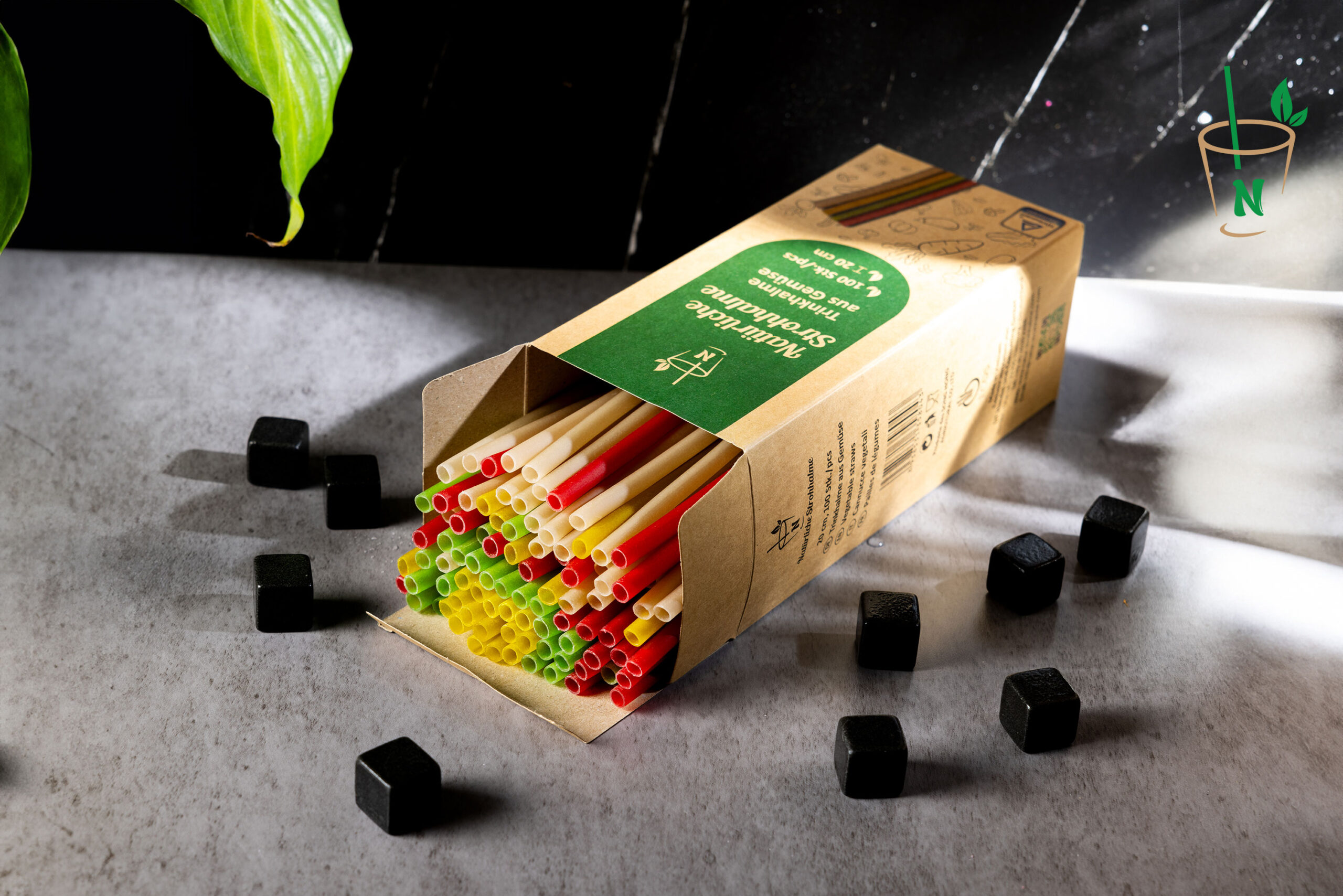
Today our vegetable straws are made from 57% tapioca root and 42% arrowroot starch, coloured with natural ingredients. They are made from plant starch, hygienic and versatile. They are produced in an ISO 22000:2018-certified factory — an internationally recognised food-safety management system that secures every step from raw material to packaging. The product has also been awarded 5-star OCOP status (One Commune, One Product), a state seal for especially high-quality, sustainable products.
How the straws are made
1. Prepare the raw materials: tapioca root and arrowroot are cleaned, dried, milled and sieved into a fine starch. 2. Mix and knead: the starch is worked with water into a smooth, dough-like mass — the right consistency decides stability. 3. Steam at 120–180°C: reliably kills all germs, with no chemicals. 4. Shaping: the mass is pressed into the straw form, in four sizes. 5. Gentle drying: after cutting, the straws are cold-dried so they stay firm. 6. Quality control: every straw is checked. Rejected straws become fish feed — nothing is wasted.
The benefits at a glance
- 100% plant-based, EU-compliant, vegan and plastic-free
- Taste-neutral, odourless and gluten-free
- Made from plant starch, no glue — see why our straws are uncoated
- Edible and made from tapioca and arrowroot starch
- Stays firm for up to 2 hours, in cold and warm drinks alike
- Four natural colours: beige (natural), yellow (turmeric), red (beetroot), green (pandan)
- Four sizes (Ø 6 / 8 / 10 / 12 × 200 mm) — one for every drink
A straw that creates jobs
The story doesn’t end with the product. Today the vegetable straws are made in a cooperative in rural Vietnam. It creates jobs for people in the region — many of them women who previously had little access to a stable income. Farmers earn extra income, families gain new prospects. And surplus vegetables take on new meaning: what was once thrown away now becomes a product that keeps value in the region.
FAQ
Who invented vegetable straws? Vietnamese farmer Lê Văn Tám from Đông Anh near Hanoi. From the sight of wasted vegetables and plastic litter, he spent years developing a straw made from plant starch — today produced in an ISO 22000:2018-certified factory. What are vegetable straws made of? From 57% tapioca root and 42% arrowroot starch, coloured with natural ingredients like beetroot, turmeric and pandan. No coating and no glue. Vegan, gluten-free, made from tapioca and arrowroot starch. Are vegetable straws really sustainable? Yes. They are plastic-free and edible, made from tapioca and arrowroot starch. They also make use of surplus vegetables and create jobs in rural regions.
Become part of the story
With every vegetable straw, you write a little more of this story — a story of courage, creativity and perseverance. Of a farmer who refused to accept that good vegetables go to waste. What looks like a small straw has a big effect: less plastic waste, new purpose for surplus vegetables, and work for rural regions in Vietnam. A small straw — a big story. And you can be part of it.
Ready to switch your business to straws made from real vegetables? Order our natural straws today and put something on the table your guests will remember.
St. Martin and the art of sharing: an old idea for a new kind of hospitality
In early November, darkness falls early. And then, on an evening around 11 November, they...
Read morePaper straws: less green than you think. What a study from South Korea shows
When the plastic straw disappeared from Europe’s bars in July 2021, the paper straw was...
Read moreMicroplastics in the glass: what research says about beverages
A guest orders a still water, you serve it in a clean glass, nothing looks...
Read moreGuests with allergies at the bar: what they ask before they order
A guest sits down at your bar, glances at the cocktail menu and asks before...
Read moreCreative Halloween Decor with NaturStrohhalme: Have You Thought of This Yet?
For many bars and restaurants, Halloween is the one time of year when decor matters...
Read moreFederweißer, pumpkin, apple: the autumn menu 2026
Evenings are getting cooler, guests are trading Aperol for something warmer, and suddenly your bar...
Read moreA short history of the drinking straw, up to the natural straw
Some words give away their own origin, and the German word for drinking straw, „Strohhalm”,...
Read more57 % tapioca, 42 % arrowroot: what’s actually inside the straw
There’s one question almost every buyer asks us before placing a first pallet order: “So...
Read more